

In the previous three blogs of this series, “No-Code vs Low-Code vs Custom Development – The 2026 Decision Guide,” “How AI Is Rewriting the No-Code vs Low-Code vs Custom Development Debate,” and “No-Code vs Low-Code vs Custom Development in 2026: What Should Businesses Choose?”, we explored the foundations of No-Code, Low-Code, and Custom Development, how AI is reshaping software development, and how the three approaches compare across speed, cost, scalability, security, performance, and AI readiness.
Now comes the more practical question:
Which approach makes sense for a specific business at a specific stage of growth?
There is no universal winner. The right choice depends on what you are building, how mature the business is, and how complex the product needs to become. I have penned down some real-world scenarios that make the differences clearer!
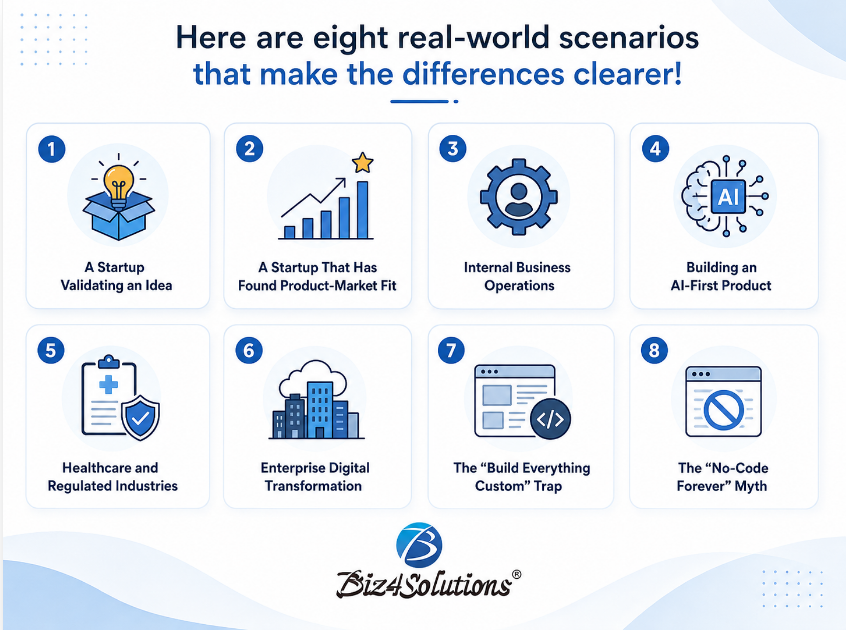
Scenario 1: A Startup Validating an Idea
Imagine a startup connecting pet owners with certified trainers. There are no customers yet, no proven demand, and no certainty that users will pay. The goal is not to build perfect software. It is to answer: “Does anybody actually want this product?”
Recommended Approach: No-Code
Platforms such as Bubble or FlutterFlow can help founders launch quickly, collect feedback, and validate assumptions without a large engineering investment.
At this stage:
- Speed matters more than perfection.
- Learning matters more than optimization.
- Customer feedback matters more than architecture.
Think of the MVP as an experiment, not the final product.
Scenario 2: A Startup That Has Found Product-Market Fit
Now imagine the same startup two years later.
It has: * 25,000 active users * Paying customers * More API integrations * AI-powered recommendations * Multiple subscription plans
The platform that helped the business launch may now be limiting performance, integrations, and feature development.
Recommended Approach: Transition toward Custom Development
This does not necessarily mean rebuilding everything at once. A phased migration can move strategic functionality into a custom architecture while keeping parts of the original system running.
The key is recognizing when business growth has started to outpace platform capability.
Scenario 3: Internal Business Operations
A manufacturing company wants to digitize: * Leave approvals * Asset requests * Purchase approvals * Maintenance schedules
The system will be used by around 150 employees and does not require a sophisticated customer-facing experience.
Recommended Approach: Low-Code
Platforms such as Microsoft Power Apps, Mendix, or OutSystems can be well suited to forms, approvals, dashboards, reporting, and workflow automation.
Building everything from scratch may add engineering effort without creating equivalent business value.
Scenario 4: Building an AI-First Product
Suppose an application needs to: * Process video uploads * Use LLMs for analysis * Store vector embeddings * Use RAG * Coordinate AI agents * Generate personalized reports * Integrate with external CRMs
This is no longer simply an application. It is an AI platform.
Recommended Approach: Custom Development
Advanced AI products often require greater control over: Prompt and model orchestration Model switching Security Observability Performance Business-specific logic * Complex integrations
No-Code and Low-Code can support AI integrations, but as AI architecture becomes more specialized, custom development usually offers greater flexibility.
Scenario 5: Healthcare and Regulated Industries
Consider a healthcare provider building a patient engagement platform with: * Patient records Appointments * Teleconsultations * AI-assisted summaries * Audit trails * Role-based access * Compliance requirements
Recommended Approach: Custom Development
Regulated systems often require greater control over data storage, authentication, encryption, logging, infrastructure, and compliance processes. Custom Development can support HIPAA-compliant solutions when the application, infrastructure, data handling, access controls, audit mechanisms, and operational processes are designed and implemented to meet HIPAA requirements.
Custom Development does not automatically guarantee compliance, but it provides the architectural flexibility and control needed to build systems around complex regulatory requirements such as HIPAA.
Scenario 6: Enterprise Digital Transformation
A global enterprise wants to modernize Finance, Procurement, HR, Supply Chain, and Customer Support. Some applications are simple. Others require deep ERP, CRM, and AI integrations.
Recommended Approach: Hybrid Strategy
A practical combination may be:
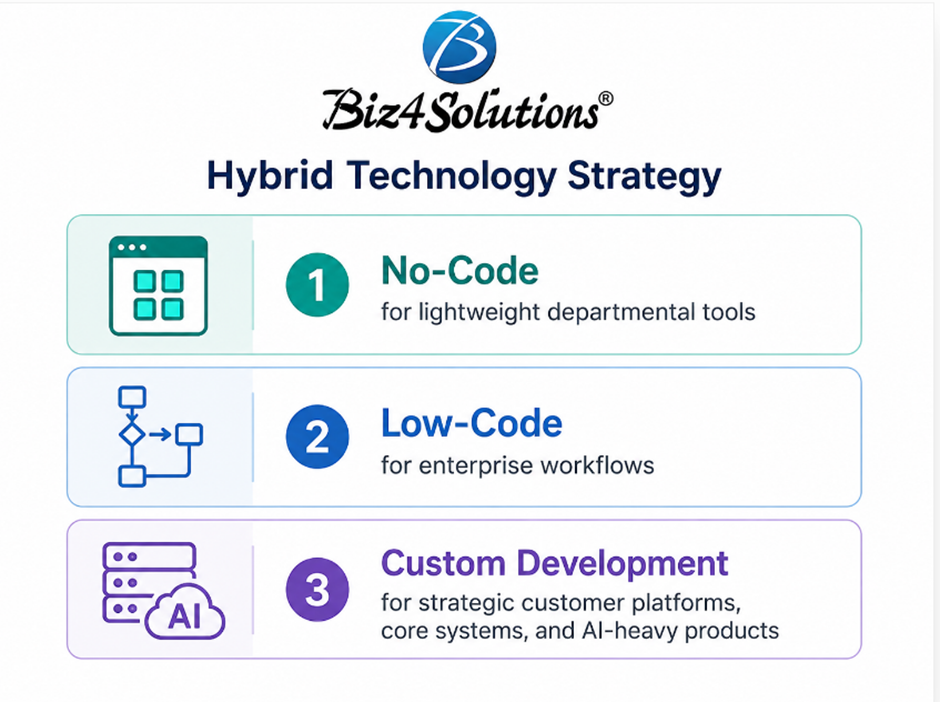
The objective is not to standardize everything on one technology. It is to use the right level of engineering for each problem.
Scenario 7: The “Build Everything Custom” Trap
Imagine a 30-person business needing employee onboarding, expense approvals, visitor management, and IT support requests.
Could these systems be custom-built? Yes.
Should they be? Probably not.
Recommended Approach: No-Code or Low-Code: Engineering effort should be focused where software creates differentiation or competitive advantage.
Not every problem deserves a custom solution.
Scenario 8: The “No-Code Forever” Myth
The opposite mistake is staying with the original platform long after the business has outgrown it.
As the product grows: * Integrations multiply * Workarounds increase * Plugins become critical * Performance issues appear * New features become harder to deliver
Eventually, a platform chosen for speed can begin slowing innovation.
Recommended Approach: Reassess and Evolve: Technology decisions should be revisited as the product and business mature.
The Best Technology Strategy Is Often Evolutionary
A platform decision does not have to be permanent. A common journey may look like this:
The technology evolves because the business evolves.
Key Takeaway
The decision should not begin with identifying the “best” technology.
It is: “Which development strategy can address the business’s current requirements without restricting future opportunities?”
The strongest technology choices align engineering investment with business maturity.
Coming Next
In the next article, we will examine Common Mistakes Businesses Make When Choosing a Development Approach, including over-engineering too early, staying on a platform too long, ignoring vendor lock-in, and picking the tech stack based on current trends rather than business requirements. Because choosing the right technology matters.
The real value lies in choosing it for the reasons that genuinely support the business.