
“Should we build it using Bubble?”
“Can FlutterFlow save us six months?”
“Should we invest in custom development from day one?”
These are some of the most common questions businesses ask before starting a new software project.
Just a few years ago, the answer was relatively straightforward. If you wanted a scalable application, you hired a software development team. If you wanted something simple, you used a website builder or a spreadsheet.
As of 2026, substantial changes had reshaped the landscape.
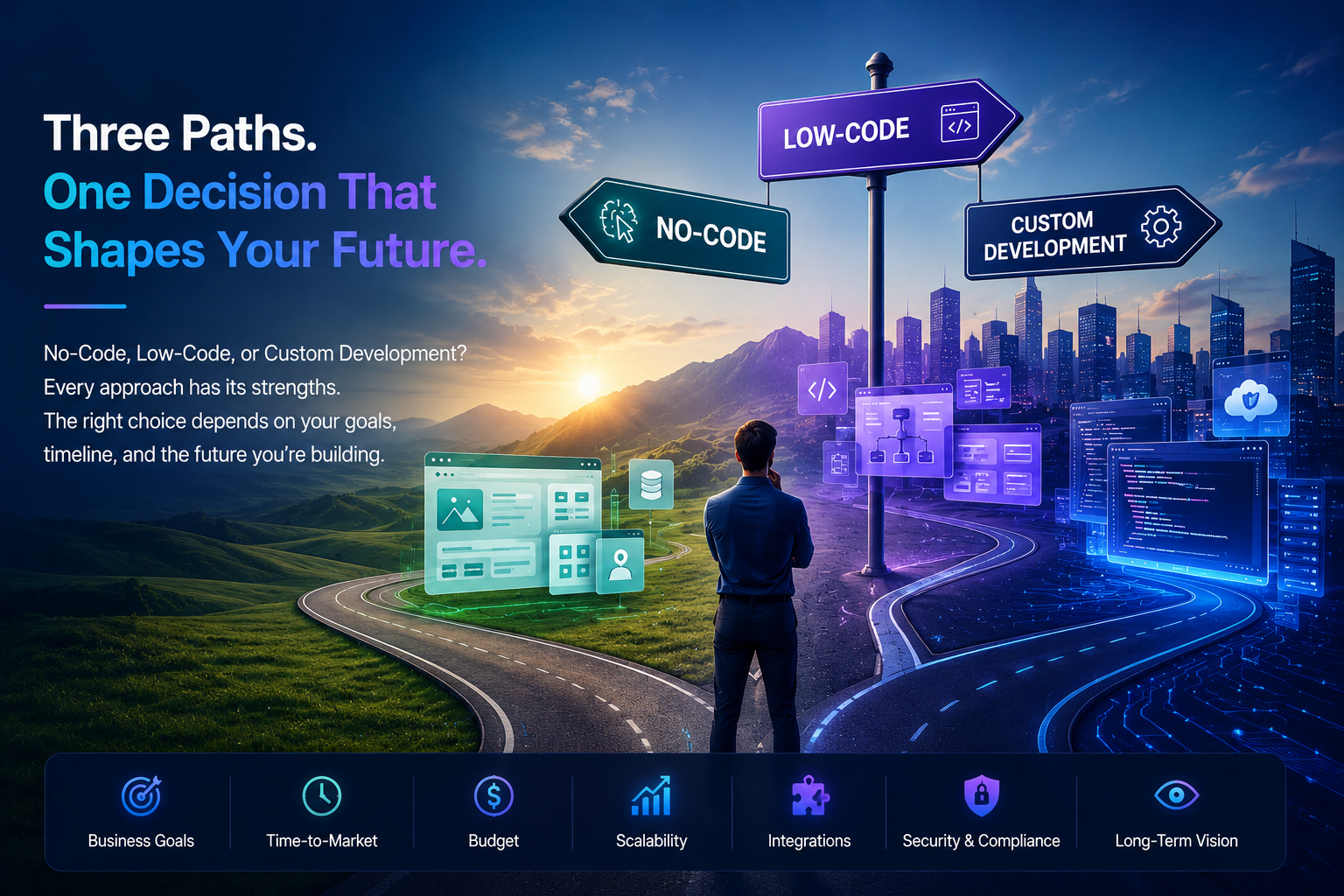
Today, businesses have three distinct paths:
· No-Code platforms that allow non-developers to create applications visually.
· Low-Code platforms that blend drag-and-drop development with custom programming.
· Custom Development, where applications are built entirely through code using frameworks such as React, Flutter, Next.js, or .NET.
What has truly changed the conversation, however, is the rapid adoption of AI-assisted development, which is redefining both the speed and economics of building software. Modern AI coding tools have significantly accelerated custom development, narrowing the traditional speed advantage enjoyed by no-code and low-code platforms.
As a result, the question is no longer “Which option is cheaper?” Instead, it has become:
Which approach will best support our business; not just today, but three years from now?
There is no universal answer.
A startup validating an idea has very different priorities from a healthcare company handling sensitive patient records. Likewise, an internal HR workflow has different technical demands than a customer-facing SaaS platform expected to serve thousands of concurrent users.
The right choice depends on several factors:
· Business objectives
· Time-to-market
· Budget
· Expected scale
· Integration requirements
· Regulatory obligations
· Long-term product vision
Choosing the wrong approach can have lasting consequences. We’ve seen startups outgrow their no-code platforms within a year, forcing expensive rewrites. We’ve also seen organizations spend months building custom software for internal tools that could have been delivered in a few days using a low-code platform.
The key isn’t choosing the most sophisticated technology; it’s choosing the technology that aligns with the problem you’re solving.
In this article, we’ll compare no-code, low-code, and custom development across the dimensions that matter most in 2026:
More importantly, we’ll provide a practical decision framework to help you determine which approach is best suited for your business.
Let’s begin by understanding what these three development approaches actually mean; and why the lines between them are becoming increasingly blurred.
What Do No-Code, Low-Code, and Custom Development Really Mean?
The terms no-code, low-code, and custom development are often used interchangeably, but they represent fundamentally different approaches to building software. Understanding these differences is the first step toward making an informed technology decision.
No-Code Development: Building Software Without Writing Code
No-code platforms enable users to create applications using visual interfaces instead of traditional programming. Features are assembled through drag-and-drop components, predefined workflows, and configuration panels.
Popular examples include:
· Bubble
· FlutterFlow
· Glide
· Softr
· Webflow
· AppSheet (for certain use cases)
These platforms are designed to empower business users, entrepreneurs, and product teams to build functional applications without deep programming knowledge.
Where no-code shines:
· Rapid MVP development
· Internal business tools
· Proof-of-concept applications
· Customer portals
· Workflow automation
· Simple marketplaces and directories
The biggest advantage is speed. A prototype that might take weeks using traditional development can often be assembled in a matter of days.
However, speed comes with trade-offs. As applications grow in complexity, limitations around customization, integrations, performance, and platform dependencies become more apparent.
Low-Code Development: Combining Visual Development with Code
Low-code platforms occupy the middle ground.
They provide visual builders to accelerate development while allowing developers to write custom code when needed. This balance offers greater flexibility without sacrificing productivity.
Well-known low-code platforms include:
· Microsoft Power Apps
· OutSystems
· Mendix
· Retool
· Appian
Unlike no-code platforms, low-code solutions are typically aimed at professional developers and enterprise IT teams rather than non-technical users.
Common use cases include:
· Enterprise workflow automation
· CRM extensions
· Internal dashboards
· Approval systems
· Operational management tools
· Department-specific applications
Organizations benefit from shorter development cycles while retaining the ability to integrate with existing enterprise systems and implement custom business logic.
That said, low-code platforms still introduce dependencies on proprietary ecosystems and licensing models, which can influence long-term costs and flexibility.
Custom Development: Building Software Without Platform Constraints
Custom development involves building applications entirely through programming using modern frameworks and cloud services.
Typical technology stacks include:
· Frontend: React, Angular, Vue.js, Next.js
· Mobile: Flutter, React Native, Swift, Kotlin
· Backend: Node.js, Python, Java, .NET, Go
· Databases: PostgreSQL, MySQL, MongoDB
· Cloud: AWS, Azure, Google Cloud
Unlike no-code and low-code solutions, custom development provides complete control over architecture, user experience, integrations, security, and scalability.
This approach is particularly well-suited for:
· SaaS products
· AI-powered applications
· Healthcare systems
· Financial platforms
· Enterprise software
· E-commerce platforms
· High-performance mobile applications
Historically, custom development required significantly more time and investment than visual development platforms.
However, that equation has shifted considerably with the rise of AI-assisted engineering. Modern development tools now automate code generation, testing, documentation, and repetitive programming tasks, enabling experienced engineering teams to deliver production-ready software much faster than before.
Final Thoughts
For years, businesses evaluated software development using a familiar trade-off:
Speed vs. Flexibility.
If you wanted to move quickly, you chose No-Code. If you wanted complete control, you invested in Custom Development. Low-Code sat somewhere in between.
In 2026, that trade-off is no longer as clear-cut.
AI-assisted engineering has accelerated custom development to a point where businesses can build sophisticated, scalable applications much faster than ever before. At the same time, No-Code and Low-Code platforms continue to evolve, making application development accessible to a broader audience.
This doesn’t make one approach universally better than another; it simply makes the decision more strategic.
Today, success isn’t about choosing the latest platform or following industry trends. It’s about selecting the approach that aligns with your business goals, technical complexity, growth ambitions, and long-term vision.
The technology landscape has changed. The way we evaluate it needs to change as well.
What’s Next?
Understanding the different development approaches is only the first step.
The more important question is:
How do they compare when it comes to speed, cost, scalability, AI readiness, security, and long-term business value?
In Part 2, we’ll compare No-Code, Low-Code, and Custom Development across the factors that matter most to founders, CTOs, and business leaders; helping you determine which approach is the right fit for your next software initiative.
I’d love to hear your thoughts: Has AI changed the way your organization approaches software development, or are the same evaluation criteria still driving your technology decisions?