
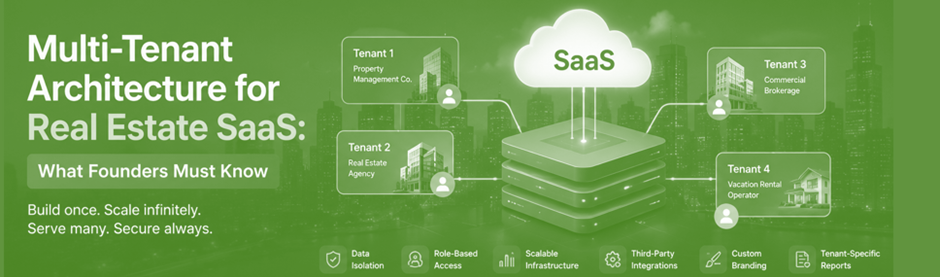
Why are some real estate SaaS platforms able to onboard hundreds of agencies, brokers, property managers, and investors without slowing down, while others struggle with performance, rising cloud costs, and data management chaos?
The answer often lies in one critical architectural decision made very early in the product journey: multi-tenant architecture.
As PropTech continues to evolve rapidly, founders are building platforms for property management, brokerage operations, leasing workflows, tenant engagement, smart buildings, CRM automation, investment analytics, and AI-driven real estate operations. But scaling these products successfully requires more than a polished UI or feature-rich dashboard.
The real challenge begins when multiple customers start using the same platform simultaneously with different workflows, permissions, integrations, and data privacy expectations.
So, what exactly should founders know before building a multi-tenant real estate SaaS platform?
Let’s break it down.
What Is Multi-Tenant Architecture?
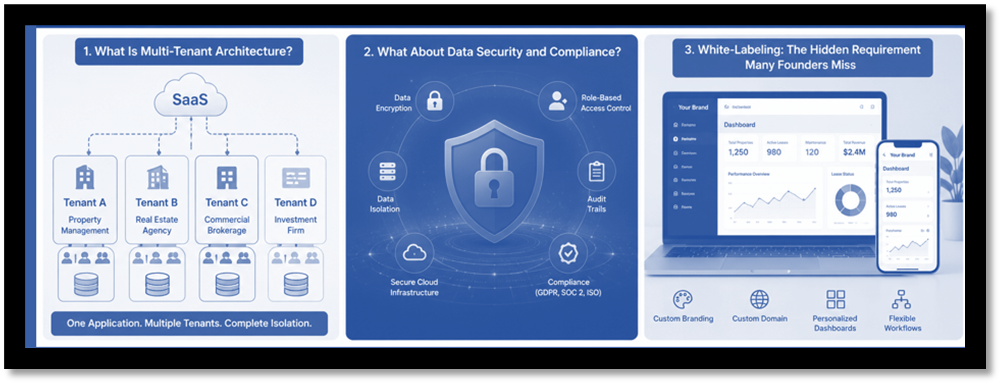
In simple terms, a multi-tenant SaaS architecture allows multiple customers (tenants) to use the same application infrastructure while keeping their data securely isolated.
For example, a property management company in Texas, a commercial brokerage in Dubai, a co-living startup in London, or a vacation rental operator in Goa can all use the same platform, while experiencing it as if it were built exclusively for them.
Each tenant may have their own branding, user roles, property portfolios, CRM workflows, reports, AI automations, third-party integrations, and billing rules. But underneath, the application runs on a shared infrastructure model.
This is what makes SaaS scalable.
Why Is Multi-Tenant Architecture Becoming Critical in PropTech?
Real estate businesses are rapidly digitizing operations: Leasing, Maintenance, Tenant communication, Financial reporting, Smart facility management, AI-driven lead qualification, Investor dashboards, Construction coordination, and Vendor workflows.
Now imagine building separate deployments for every customer.
The operational complexity becomes unsustainable.
This is why modern PropTech startups increasingly adopt multi-tenant cloud architectures powered by:
· AWS · Azure · GCP · Kubernetes · Serverless systems · AI-enabled workflow engines · Event-driven microservices
Founders who design scalability early gain a significant competitive advantage later.
The Biggest Mistake Real Estate SaaS Founders Make
Many founders start with a single-customer mindset.
Initially, this feels faster:
· One database
· Hardcoded workflows
· Shared admin logic
· Minimal permission control
But what happens after onboarding 20 clients?
Suddenly:
· One client wants custom reporting
· Another needs region-specific compliance
· Enterprise customers demand SSO
· Brokers require hierarchy-based permissions
· Property managers need data segregation guarantees
· Investors ask for white-labeled dashboards
At this point, retrofitting multi-tenancy becomes expensive and risky.
This is one of the biggest architectural traps in SaaS product development.
Shared Database vs Separate Database: Which Model Works Best?
This is one of the most important decisions founders come across.
1. Shared Database, Shared Schema
All tenants share the same database and tables, separated using Tenant IDs.
Advantages
· Lower infrastructure cost
· Easier deployment
· Faster scaling
· Simplified maintenance
Challenges
· Complex query optimization
· Higher security responsibility
· Risk of noisy-neighbour performance issues
This model works well for:
· Early-stage SaaS
· MVPs
· Fast-scaling startup environments
2. Shared Database, Separate Schema
Each tenant has a dedicated schema inside the same database.
Advantages
· Better isolation
· Easier tenant-level customization
· Improved migration flexibility
Challenges
· More operational complexity
· Schema management overhead
This model is often preferred by mid-sized SaaS platforms.
3. Separate Database per Tenant
Every tenant gets an independent database.
Advantages
· Strong isolation
· Enterprise-grade compliance
· Easier backup/recovery
· Better for high-security customers
Challenges
· Higher cloud costs
· DevOps complexity
· Scaling challenges
This is common in:
· Enterprise PropTech
· Financial real estate platforms
· High-compliance regions
What About Data Security and Compliance?
Real estate platforms often handle: Financial records, Lease agreements, Identity documents, Payment data, Legal contracts, Maintenance history, and Occupancy analytics.
Now imagine a tenant accidentally accessing another customer’s data.
That’s a business-ending event.
This is why founders must think deeply about Row-level security, Tenant-aware APIs, Encryption, Audit trails, Access control, RBAC/ABAC models, Secure cloud storage, Compliance readiness, and Security while developing the software itself. This cannot be treated as a post-launch feature.
How Does AI Change Multi-Tenant SaaS Design?
AI is fundamentally reshaping PropTech platforms. Today’s real estate SaaS products increasingly include:
· AI lead scoring ·Automated tenant communication ·Lease abstraction ·AI copilots ·Property recommendation engines ·Predictive maintenance ·Smart pricing ·Document summarization
But AI introduces new architectural questions:
· Should embeddings be shared?
· How do you isolate vector databases?
· Can one tenant’s AI model learn from another tenant’s data?
· How do you handle LLM cost optimization?
This is where many SaaS products become operationally expensive.
A scalable AI-enabled multi-tenant architecture requires:
· Tenant-isolated vector storage
· Usage-aware AI billing
· Async AI processing pipelines
· Queue-based orchestration
· Caching strategies
· Token usage governance
Founders ignoring this early often face exploding AI infrastructure costs later.
Why Performance Optimization Becomes a Serious Challenge
Real estate systems generate large operational datasets: Property images, Floor plans, Inspection reports, Video walkthroughs, Maintenance logs, IoT sensor data, CRM activities, and Document archives.
As tenants grow, performance bottlenecks emerge quickly.
Questions founders should ask:
· How will search scale?
· Can dashboards handle large portfolios?
· What happens during peak leasing seasons?
· Can analytics run without slowing transaction workflows?
This is why scalable PropTech systems increasingly adopt: Distributed caching, CDN strategies, Read replicas, Event streaming, Background workers, Elastic search systems, and Data partitioning.
Should Founders Build Microservices from Day One?
Not necessarily. This is another common misconception. Early-stage startups often over-engineer. A modular monolith with clean tenant isolation can scale surprisingly well in the beginning.
The smarter approach is:
1. Build fast
2. Validate market fit
3. Design boundaries properly
4. Gradually extract services when scale demands it
Premature microservices can slow product velocity significantly.
White-Labeling: The Hidden Requirement Many Founders Miss
In real estate SaaS, white-labeling becomes extremely important.
Agencies and property firms often want their own branding, custom domains, personalized dashboards, region-specific workflows, custom reports, and local integrations.
If the architecture isn’t designed for tenant configurability early, these become painful engineering problems later.
What Investors and Enterprise Clients Usually Evaluate
Many founders focus only on features. But enterprise buyers and investors often ask:
· Can the platform scale globally?
· How isolated is tenant data?
· What happens during outages?
· Is the architecture cloud-native?
· How fast can new customers onboard?
· Can enterprise compliance requirements be met?
· Is the system API-first?
Architecture directly influences business valuation.
Real-World Example: Scaling Multi-Tenant SaaS Platforms
At Biz4Solutions, we’ve worked on SaaS platforms across fintech, healthcare, communication systems, workforce management, and AI-enabled automation ecosystems where multi-tenant scalability became central to long-term product success.
For example:
· DebtManage involved scalable SaaS workflows, role-based dashboards, financial integrations, and cloud-native architecture.
· Tele-management System required multi-tenant dashboarding, carrier intelligence workflows, analytics pipelines, and role-driven operational access.
· Beach Caddy demonstrated how real-time operations, geo-tracking, notifications, and high user concurrency impact architectural decisions at scale.
These cross-domain learnings become highly relevant when building modern PropTech ecosystems where reliability, scalability, and operational flexibility are critical.
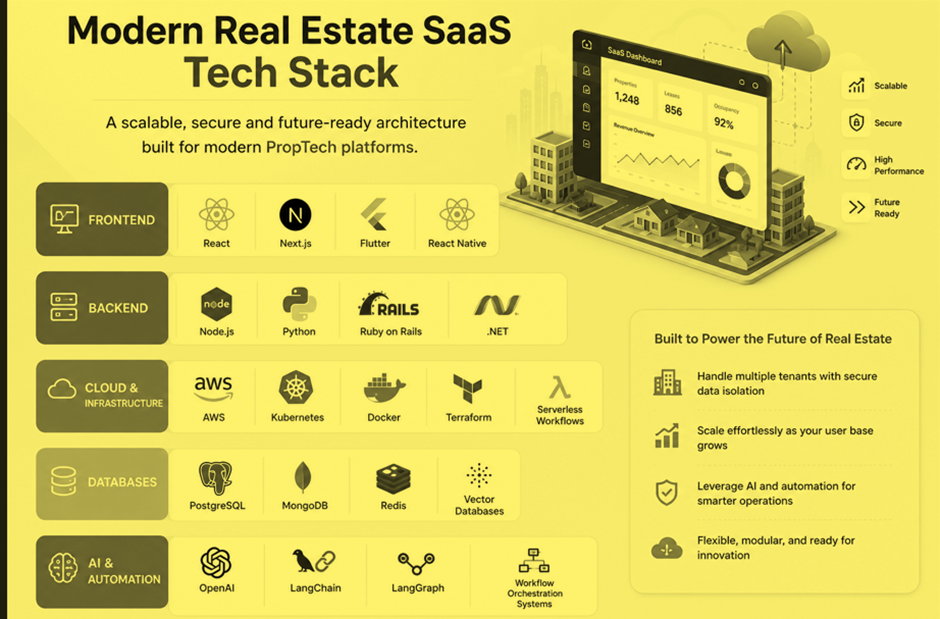
What Tech Stack Is Commonly Used for Modern Real Estate SaaS?
While stack selection depends on product goals, many scalable SaaS systems today commonly use:
· Frontend: React, Next.js, Flutter, React Native
· Backend: Node.js, Python, Ruby on Rails, .NET
· Cloud & Infrastructure: AWS, Kubernetes, Docker, Terraform, Serverless workflows
· Databases: PostgreSQL, MongoDB, Redis, Vector databases
· AI & Automation: OpenAI, LangChain, LangGraph, Workflow orchestration systems
The real differentiator is not the framework itself; it’s how well the architecture supports scale, isolation, performance, and future extensibility.
Final Thoughts
Building a real estate SaaS platform today is no longer just about creating dashboards and property listings.
The real competitive advantage comes from designing a platform that can onboard tenants efficiently, scale without operational chaos, support AI workflows, maintain strong security, optimize infrastructure costs, and evolve rapidly as the market changes.
Multi-tenant architecture is not just a technical decision. It is a long-term business strategy. And founders who get it right early often create platforms that scale faster, attract stronger enterprise clients, and become significantly easier to evolve over time.
The question is no longer: “Should we build multi-tenant?”
The bigger question is: “How well prepared is our architecture to support the next five years of evolution in the PropTech space?”