

For many real estate providers, the problem is not just getting more leads. The harder problem is identifying which buyers are serious, responding before interest fades, matching them with the right listings, coordinating showings quickly, and moving them toward mortgage-readiness and closing without unnecessary friction.
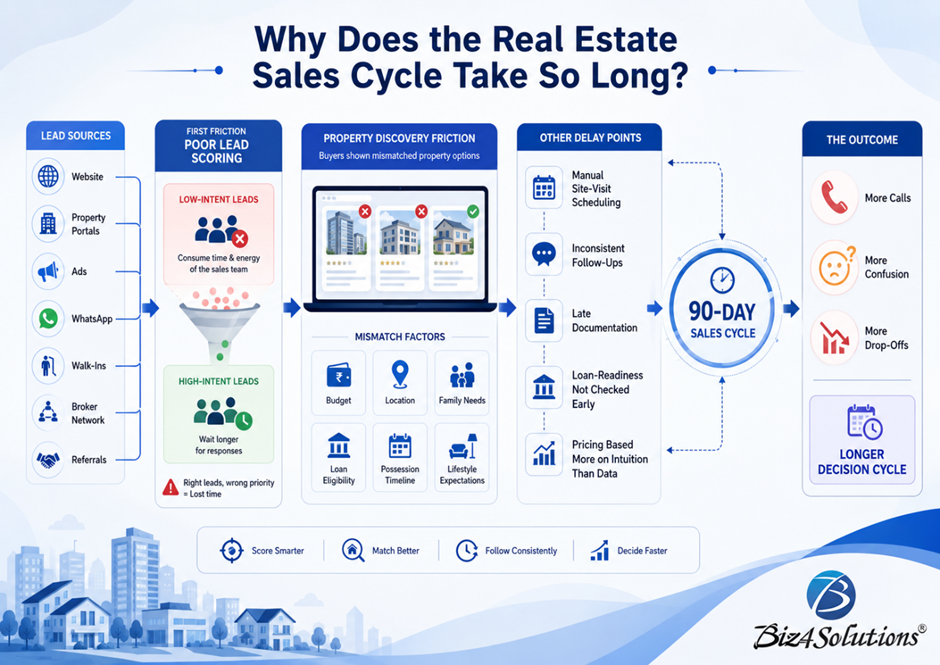
A long real estate sales cycle is rarely caused by one single delay. It usually happens because small gaps keep adding up across the buyer journey.
· A lead waits too long for a response.
· A buyer receives listings that do not match their budget, lifestyle, school district preference, commute expectations, or move-in timeline.
· A showing is not scheduled fast enough.
· Follow-ups become generic.
· Mortgage pre-approval is discussed too late.
· Transaction steps such as disclosures, inspection, appraisal, title, escrow, and documentation remain scattered across different systems.
This is exactly where AI in real estate can make a practical difference. Not by replacing agents, brokers, leasing teams, or sales representatives, but by helping them work faster, prioritize better, and personalize the buyer journey at scale.
Why Are US Real Estate Sales Cycles Still So Slow?
The US real estate market is already highly digital, but many sales operations are still fragmented. Buyers may come from brokerage websites, IDX search pages, Zillow, Realtor.com, Redfin, Google Ads, Facebook and Instagram campaigns, open houses, model home visits, agent referrals, phone calls, SMS inquiries, and CRM landing pages. But once the lead enters the system, many real estate teams still rely on manual qualification, inconsistent follow-ups, disconnected spreadsheets, and basic CRM notes.
According to the National Association of REALTORS®, buyers spent a median of 10 weeks searching for a home in 2025, and 52% found their home through an online search. That means the digital discovery phase is already central to the US home-buying journey, but the sales workflow behind that discovery often remains slow, reactive, and heavily dependent on manual coordination.
For real estate brokerages, agent teams, home builders, leasing companies, property managers, and PropTech platforms, the real challenge is no longer just online visibility. The bigger challenge is converting digital interest into qualified conversations, scheduled showings, serious offers, and completed transactions faster.
Can AI Really Reduce a 90-Day Sales Cycle to 30 Days?
With AI usage, the sales cycle can be minimized, if it’s used to remove delay points throughout the journey. It cannot force a buyer to make a decision, and it cannot eliminate market realities such as mortgage rates, appraisal timelines, inspection issues, or title dependencies. But it can compress the time wasted before a serious buyer reaches the right property, the right agent, and the right next step.
For example, an AI-powered real estate CRM can analyze lead behavior across multiple touchpoints. A consumer who repeatedly views the same listing, saves homes in a specific neighborhood, checks mortgage estimates, opens emails, and requests school district information shows strong buying intent. They should not be treated the same as someone who casually filled out a form just once. AI lead scoring helps sales teams separate high-intent buyers from low-intent traffic. This allows agents and inside sales teams to prioritize the prospects most likely to move forward in the near term. Instead of spending days chasing cold leads, teams can focus on buyers who are showing real purchase signals.
How Does AI Improve Lead Qualification for Real Estate Providers?
Lead qualification is one of the biggest bottlenecks in real estate sales. Many teams receive leads from different platforms, but they do not always know which source is producing serious buyers, which inquiries need immediate follow-up, and which prospects are still early in the research stage.
AI can evaluate buyer intent using data points such as search activity, budget range, preferred ZIP codes, saved listings, requested showings, mortgage pre-approval status, engagement history, communication response time, and property comparison behavior.
For a brokerage, this means agents can receive a ranked list of leads instead of a flat contact list. For a home builder, this means sales teams can identify which buyers are ready for a model home tour. For a leasing company, this means the team can prioritize renters who are ready to move within a defined lease-start window. For a PropTech platform, this means better conversion analytics and more intelligent buyer routing.
The result is simple: the right lead reaches the right person faster.
Why Do Buyers Drop Off During Property Discovery?
Many buyers do not drop off because they are uninterested. They drop off because the process becomes confusing. They are shown too many homes, the wrong homes, or listings that do not match their actual decision criteria.
Homebuyers often consider far more than just price or square footage. Factors like commute convenience, school districts, HOA costs, property taxes, insurance expenses, neighborhood walkability and safety, resale opportunities, rental income potential, pet regulations, nearby medical facilities, and the home’s readiness for immediate move-in can all influence their decision.
A custom AI property recommendation engine can go beyond standard search filters. It can understand buyer preferences and recommend homes based on a richer decision profile. Instead of showing 40 listings that technically match a ZIP code and price range, the system can recommend 5 to 7 better-fit options based on lifestyle, financing readiness, urgency, and previous interactions.
This is where custom real estate software development becomes powerful. A generic property search experience can show listings. A custom AI-powered real estate platform can guide buyers toward better decisions.

How Can AI Speed Up Buyer Conversations Without Making Them Feel Robotic?
Real estate in the US is still built on confidence, timing, and human trust. Buyers expect fast answers, but they also want to feel understood. When a chatbot gives canned replies, it can make the experience feel impersonal. But when an AI assistant is designed around real buyer intent, property data, and sales context, it can support the conversation in a much more natural way.
For example, a buyer may be looking for a three-bedroom home within a specific budget, close to downtown Austin, in a pre For home builders, ferred school district, and available within a short move-in window. A basic chatbot may only respond with a broad list of homes or ask the buyer to wait for an agent. A smarter AI sales assistant can interpret the request, check available listings, consider location and budget constraints, compare matching homes, estimate likely monthly payments, and suggest the next practical step, such as scheduling a showing.
For US real estate providers, the real value comes when the AI assistant is not working in isolation. It should connect with IDX or MLS listing feeds, CRM data, current inventory, showing calendars, SMS and email workflows, mortgage partner processes, and previous buyer interactions. When these systems work together, AI becomes more than a front-end chatbot. It becomes a connected sales support layer that helps agents respond faster while keeping the experience personal.
What Happens After the Showing?
Many real estate opportunities lose momentum after the first showing. The buyer may be interested, but the next step is not always clear. The agent may not have a complete record of what the buyer liked, what concerns came up, or which competing properties the buyer is still considering. In the case of home builders, the buyer may also be waiting for floor plan comparisons, financing options, incentive details, or availability updates.
AI can help organize this post-showing stage. It can summarize the buyer’s feedback, capture objections, identify likely concerns, and suggest a follow-up action for the agent. If the buyer is worried about affordability, the system can recommend sending mortgage payment estimates. If the buyer likes the neighborhood but hesitates on price, the platform can prepare comparable property information or recent market data. If the buyer asks about schools, commute time, or HOA fees, the system can help the agent respond with relevant information quickly.
This does not reduce the importance of the agent. It gives the agent better context, faster access to information, and a clearer path for the next conversation.
Can AI Help with Mortgage-Readiness and Closing Coordination?
Yes. In the US market, deals often slow down because key steps are spread across different people, systems, and timelines. Mortgage pre-approval, document collection, disclosures, inspections, appraisals, title work, escrow coordination, insurance requirements, and closing tasks may all move through separate workflows.
An AI-enabled real estate platform can help bring visibility into this process. It can show buyers what is still pending, remind them about missing documents, route tasks to the right team, summarize transaction progress, and flag delays before they put the deal at risk. For brokerages, this improves transaction visibility. For home builders, it helps sales, financing, and operations teams stay aligned without repeated manual coordination. For PropTech companies, it creates a smoother experience from search to closing.
The point is not just to add AI as another feature. The bigger opportunity is to redesign the sales and transaction workflow so that buyers, agents, managers, and support teams can act on the same information at the right time.

What Could a 30-Day AI-Enabled Real Estate Sales Journey Look Like?
A buyer may first enter through a brokerage website, listing portal, paid campaign, open house form, or referral. Instead of being added to a generic contact list, the AI system can immediately assess buyer intent based on activity, preferences, urgency, and engagement signals.
The buyer can then interact with an AI assistant that understands budget, preferred location, home type, financing readiness, commute needs, school preferences, and move-in timeline. Instead of overwhelming the buyer with too many unsuitable listings, the platform can present a focused set of relevant homes.
From there, the buyer can schedule a showing directly through the system. After the showing, the platform can generate a personalized follow-up, highlight buyer objections, and recommend the next action for the agent. Mortgage-readiness can be checked earlier, documents and disclosures can be tracked digitally, and sales managers can see which buyers are progressing and which ones are stuck.
In this type of workflow, AI does not replace the relationship between buyer and agent. It removes the delays around that relationship.
What Should Real Estate Providers Ask Before Building an AI Platform?
Before investing in AI software development, real estate leaders should first identify the areas that are slowing down the sales cycle. Is the first response taking too long? Are agents spending too much time on low-intent leads? Are buyers receiving listings that do not match their actual needs? Are showings still scheduled manually? Are follow-ups inconsistent? Is mortgage-readiness checked too late? Are transaction updates scattered across too many tools?
These questions matter because AI should solve a real operational problem. A chatbot alone will not shorten the sales cycle. A connected AI sales platform can make a much stronger impact when it improves lead prioritization, buyer communication, showing coordination, follow-up quality, and transaction visibility.
What Features Should a US-Focused AI Real Estate Platform Include?
A US-focused AI real estate platform can include AI lead scoring, IDX or MLS-connected property search, intelligent listing recommendations, AI-assisted buyer conversations, showing scheduling, CRM integration, SMS and email automation, personalized follow-up workflows, mortgage-readiness tracking, buyer journey analytics, agent dashboards, broker dashboards, open house lead capture, transaction task tracking, document workflows, e-signature integration, and sales reporting.
For PropTech startups and SaaS products, the platform may also need multi-tenant architecture, role-based access, subscription billing, API integrations, security controls, mobile apps for buyers and agents, and analytics dashboards for business performance.
The better approach is not to build every feature at once. Start with the area that creates the most delay, prove the business value, and then expand the platform in phases.
Why Build Custom AI Software Instead of Using Generic Real Estate Tools?
Generic real estate tools can support basic CRM, email automation, or listing search. But every real estate business has its own sales process, market focus, customer segments, team structure, listing strategy, compliance needs, integrations, and reporting requirements.
A brokerage may need AI lead routing and agent productivity dashboards. A home builder may need model home scheduling, inventory visibility, and buyer financing workflows. A property management company may need leasing automation and renter qualification. A PropTech startup may need a custom SaaS platform with AI-powered search, recommendations, and buyer engagement.
Custom AI software allows these workflows to be designed around the business model, not forced into a generic template.
Final Thoughts: AI Will Not Replace Real Estate Sales Teams, But It Will Redesign How They Sell
The real estate sales cycle becomes long when serious buyers are not identified early, property discovery is not personalized, follow-ups are inconsistent, showing coordination is manual, and transaction readiness is handled too late.
AI can help real estate providers reduce these delays by connecting lead intelligence, property recommendations, buyer communication, showing workflows, mortgage-readiness, and transaction visibility into one smarter system.
For brokerages, home builders, leasing companies, property managers, and PropTech startups, the opportunity is not just to use AI. The opportunity is to build a sales engine where every buyer interaction moves the deal one step closer to a decision.
A shorter sales cycle is not only a sales goal. It is a software design opportunity.