
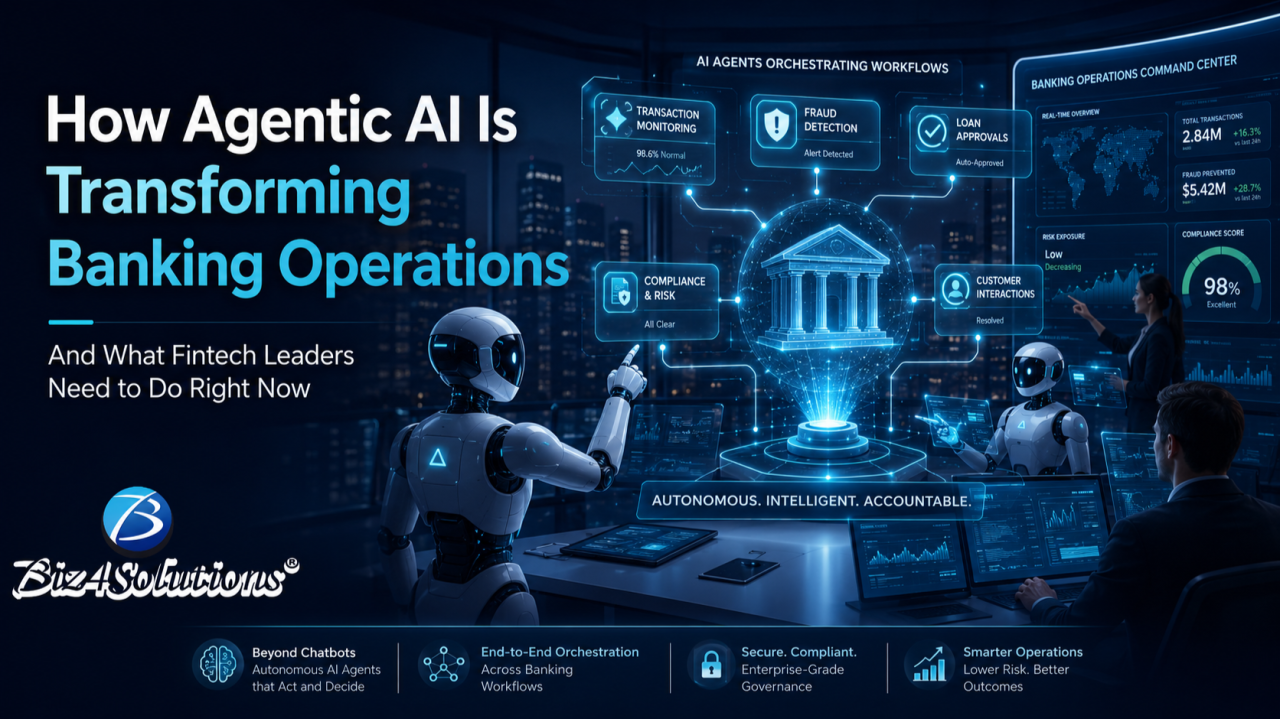
There is a moment in every technology cycle when the question shifts from “should we explore this?” to “why haven’t we started yet?” For agentic AI in banking, that moment has arrived.
The chatbot era gave banking customers a way to ask questions and get scripted answers. It was progress, but it was also a ceiling. The real transformation happening right now is not about better chatbots or smarter FAQ responses. It is about AI systems that can perceive a situation, make a decision, execute an action, and adapt when something changes – all without waiting for a human to approve every step.
That is what agentic AI means. And the gap between institutions that understand this and those still thinking in terms of “automation” is widening fast.
The Numbers That Should Be on Every CTO’s Radar
According to a report by Marketsand Markets, “the global agentic AI market stood at $5.1 billion in 2024 and is projected to surpass $47 billion by 2030, representing a compound annual growth rate of over 44.8%”.
For fintech founders and IT decision-makers still treating this as a watch-and-wait situation, these figures represent the cost of delay, not just the size of an opportunity.
What Makes Agentic AI Different from Everything That Came Before
Most banking AI to date has been reactive and single-purpose. A fraud detection model flags an anomaly. A chatbot answers a question. A credit scoring algorithm produces a number. Each of these systems does one thing in isolation, then hands off to a human.
Agentic AI changes the architecture entirely. An agent does not just flag the anomaly; it investigates it, cross-references it against account history and behavioral patterns, decides whether to block or allow the transaction, communicates with the customer if needed, and logs the entire decision trail for compliance purposes. It does this in milliseconds, across millions of transactions simultaneously, and it learns from each cycle.
The difference is not incremental. It is structural.
Think of it this way: previous AI was a tool that made humans faster. Agentic AI is a system that handles entire workflows independently, escalating to humans only when the situation genuinely requires judgment that the system cannot confidently provide.
Where Agentic AI Is Already Delivering in Banking Operations
Fraud Detection and Financial Crime Prevention
More than half of banking executives report high capability in fraud detection (56%) and security (51%) as the leading use cases for agentic AI, with banks using AI agents to continuously monitor suspicious activities and automatically respond to threats.
This is not just an efficiency gain, it is a fundamental shift in how financial crime is fought. Agents operating at transaction speed, with full context, make decisions that no human analyst could make at that volume or velocity.
Loan Origination and Credit Processing
Leading regional banks implementing agentic AI report noteworthy improvement in approval-to-funding cycles for commercial lending and a reduction in manual processing for trade finance operations.
Loan origination is one of the most document-heavy, decision-intensive processes in banking. Agents that can ingest application data, pull bureau reports, assess risk, flag exceptions, generate term sheets, and route for final sign-off represent a step-change in operational throughput, without any reduction in underwriting quality.
Compliance and Regulatory Reporting
Compliance is the area where the cost of manual labor is most visible and most painful. Regulatory requirements demand exhaustive documentation, real-time monitoring, and continuous reporting across multiple jurisdictions. An agentic system can monitor transactions against evolving rule sets, generate Suspicious Activity Reports automatically, maintain audit trails without human intervention, and adapt its behavior when regulations change.
Customer Lifecycle Management
The shift from reactive customer service to proactive lifecycle management is one of the most commercially significant applications of agentic AI. Rather than waiting for a customer to call or a churn signal to appear on a dashboard, agents can monitor behavioral indicators, identify the right intervention moment, personalize an offer, deliver it through the right channel at the right time, and capture the response; all within a single automated loop.
Banks deploying agentic AI report 35-55% faster resolution times for complex customer queries. For fintech businesses where speed and personalization are core to the value proposition, this is not a marginal improvement; it is table stakes.
The Architecture Behind Agentic Banking Systems
Understanding what makes agentic AI work in a banking context matters for CTOs and IT leaders evaluating build vs. buy decisions and integration strategies.
At the core, an agentic banking system requires four components working together.
1. The first is a reasoning layer, typically a large language model or a fine-tuned variant, that can interpret unstructured inputs (documents, conversations, transaction narratives), apply business logic, and produce structured decisions.
2. The second is a tool-use layer: the set of APIs, databases, and systems the agent can call. This is where integration depth matters most. An agent that cannot write back to the core banking system, update CRM records, or trigger downstream workflows is not truly agentic; it is still a glorified classifier.
3. The third is a memory layer: the ability to retain context across interactions, sessions, and time. This is what separates agents that learn from agents that simply repeat. Vector databases and persistent state management are the technical mechanisms behind this.
4. The fourth is a governance layer: the guardrails, audit logs, human escalation triggers, and compliance controls that make agentic systems safe to deploy in regulated environments. This layer is not optional. It is what determines whether a deployment survives its first regulatory examination.
The Honest Challenges – Because the Hype Leaves Them Out
Not everything about agentic AI in banking is smooth. The technology is mature enough to deploy, but not yet mature enough to deploy carelessly.
The primary friction points are integration complexity, data quality, and governance readiness. Core banking systems were not designed with agent interoperability in mind. Data silos persist across most institutions. And compliance teams, rightly, want to understand exactly how an autonomous system makes decisions before they sign off on it operating at scale.
The institutions winning with agentic AI are not the ones deploying maximum autonomy. They are the ones deploying precisely calibrated autonomy, with clear human oversight at the right decision points.
The practical approach: start with a contained, high-value process, prove the ROI, build organizational confidence, then scale. This is what separates successful deployments from expensive pilots that never graduate.
What This Means for Fintech Founders and Technology Leaders Specifically
Fintech companies occupy a particular position in this landscape. Unlike incumbents, you are not carrying the weight of a 40-year-old core banking system. Your data architecture is newer. Your teams are more comfortable with AI tooling. Your regulatory footprint, while real, is more navigable.
This means the gap between where you are and where agentic AI can take you is smaller, and the competitive advantage available to you is proportionally larger.
The strategic questions worth asking now are practical ones.
· Which of your current operational workflows involve the most repetitive decision-making against structured rules?
· Where does human bottlenecking create latency in customer-facing processes?
· Which compliance functions are consuming disproportionate headcount?
· Where is your false positive rate in fraud detection high enough to be costing you customer relationships?
These are the entry points. Not an enterprise transformation program. Not a three-year roadmap. Specific workflows, specific friction points, specific agents deployed against specific problems, and then expanded as the results justify the investment.
The Window Is Open, But Not Indefinitely
In late 2025, just over a quarter of banks had AI agents in production for cloud operations. By the end of 2026, adoption is expected to surge beyond 70%. The institutions making deployment decisions today are positioning themselves ahead of that wave. Those waiting for the technology to mature further are likely waiting past the optimal window.
The chatbot era taught banks that digital engagement matters. The agentic AI era is teaching them that autonomous, intelligent operations are the actual competitive moat; and it is being built right now, by the organizations willing to move with appropriate urgency.
The question for fintech founders and IT decision-makers is not whether agentic AI will reshape banking operations. It already is. The question is whether your organization is shaping that change or reacting to it.
Biz4Solutions is a software development agency specializing in AI-powered platforms, SaaS systems, and intelligent automation for fintech and financial services organizations. If you are evaluating how to build agentic AI capabilities into your banking or fintech operations, we would be glad to discuss the technical approach and share relevant experience.