
Best Practices for Developing a Secure and User-Friendly Banking App

In today’s digital age, consumers prefer using mobile apps for banking and financial transactions. Some examples include Apple Pay or Google Pay for contactless payments in stores; Banking apps to check account balances, transfer funds, pay bills, deposit checks via photo capture, and apply for loans or credit cards; insurance apps to pay premiums, file claims, and access roadside assistance; and many more.
While the convenience of using such mobile applications is undeniable, security and user experience are of utmost importance to ensure both the safety and satisfaction of users. Users expect their banking app not only to be intuitive and easy to use but also to keep their sensitive information safe. Here are the best practices for creating a secure and user-friendly banking app that meets the needs of both financial organizations and their end customers.

Banking App Development: Best Practices
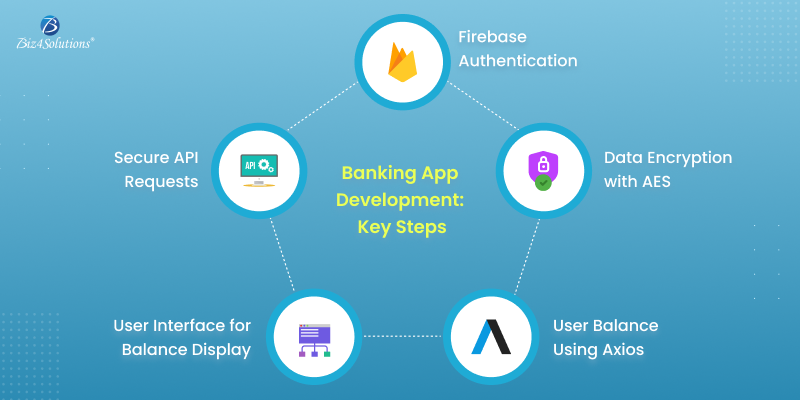
 
banking app development
User Authentication
Secure user authentication is the foundation of a safe banking app. A combination of methods—such as multi-factor authentication (MFA), biometric verification (fingerprints, facial recognition), and one-time passwords (OTPs)—creates multiple layers of security that deter unauthorized access. Using biometric authentication, for example, can enhance security while making the login experience fast and hassle-free for the user.
Best Practices:
  • Implement 2FA or MFA as a standard protocol.
  • Encourage users to enable biometric authentication
  • Use session timeouts and automatically log out users after a period of inactivity.
Data Encryption and Secure Communication Channels
If you encrypt your data following standard mechanisms; any user wouldn’t be able to read or access it without the correct decryption key. End-to-end encryption secures data during transmission, while AES (Advanced Encryption Standard) can safeguard stored data.
Best Practices:
  • Encrypt all kinds of sensitive data like personal details, account numbers, etc.
  • Use SSL/TLS certificates so that data is transmitted securely.
  • Update encryption techniques regularly to stay aligned with industry standards.
Implement Strong Access Controls
Access control is essential to prevent unauthorized access to user data and system resources. Role-based access control (RBAC) allows only authorized users and systems to access sensitive information or perform specific functions. This helps reduce the attack surface and limit potential damage from a data breach.
Best Practices:
  • Use RBAC to define user permissions
  • Review access logs for identifying unusual access patterns.
  • Establish different user roles (e.g., user, admin) with distinct access levels.
Regular Security Audits and Penetration Testing
Banks should regularly conduct security audits and penetration testing to identify vulnerabilities and areas for improvement. These tests simulate potential attack vectors and help developers patch security flaws before they can be exploited.
Best Practices:
  • Partner with third-party security firms for unbiased audits.
  • Perform routine vulnerability assessments.
  • Keep a continuous improvement cycle by scheduling regular security reviews.
User-Friendly Interface and UX Design
A secure banking app is only effective if users find it easy to use. The user interface (UI) should be designed for clarity, simplicity, and accessibility. The user experience (UX) in banking applications should minimize friction by making essential functions like logging in, viewing balances, and transferring money intuitive and quick.
Best Practices:
  • Conduct user testing to optimize the app’s UI and flow.
  • Use clear labeling and simple navigation.
  • Focus on the essential features; avoid overloading users with too many options.
Compliance with Financial Regulations
Banks operate in a highly regulated environment, and financial apps must adhere to industry standards and government regulations such as PCI DSS (Payment Card Industry Data Security Standard) and GDPR (General Data Protection Regulation) for data privacy.
Best Practices:
  • Familiarize yourself with relevant regulations (GDPR, PCI DSS, CCPA).
  • Implement data protection measures in compliance with these standards.
  • Keep records of data handling and retention policies for audits.
Implement Fraud Detection and Prevention Mechanisms
Integrating real-time monitoring systems to detect fraudulent activity can help prevent unauthorized transactions. Leveraging AI and machine learning models can improve the detection of suspicious activities, especially those that differ from typical user patterns.
Best Practices:
  • Set up alerts for unusual transaction behaviors.
  • Integrate AI-driven fraud detection models.
  • Allow users to freeze accounts and report suspicious activity directly through the app.
Regularly Update and Patch the App
Keeping the app updated is critical, as outdated software is vulnerable to attacks. Regular updates allow developers to apply patches that protect against newly discovered security threats. Furthermore, these updates can improve usability by fixing bugs and enhancing the app’s performance.
Best Practices:
  • Set up a dedicated schedule for maintenance and updates.
  • Communicate update benefits to users to encourage installations.
  • Patch security vulnerabilities immediately upon discovery.
Educate Users on Security Best Practices
A secure app design alone is not enough if users are unaware of potential security risks. Informing users about the best practices, such as avoiding public Wi-Fi when accessing mobile banking apps and setting strong passwords, helps create an additional line of defence.
Best Practices:
  • Send regular security tips and updates to users.
  • Create in-app guides or FAQs on protecting accounts.
  • Prompt users to review and update their security settings periodically.

Final Thoughts

Creating a secure and user-friendly banking app is a continuous process that requires a proactive approach to security and usability. By implementing these best practices, banks and financial institutions can ensure that their apps not only provide top-grade security but also a seamless and satisfying UX. The result? Higher user trust, better engagement, and a competitive edge over peers. Here’s a handy tip: If you don’t have a comprehensive in-house IT team, collaborating with a trusted IT partner can make all the difference.

Embedded Finance in Everyday Applications: All You Need to Know

Isn’t it super convenient to complete your payment while online shopping without ever leaving the site, book a cab and handle payment effortlessly within the ride-hailing app itself, or access buy-now-pay-later (BNPL) options on e-commerce platforms with just a few clicks? That’s the power of “embedded finance.” Financial services—like payments, lending, or insurance—are integrated directly within non-financial platforms or applications. This allows end users to make payments, get loans, or access other financial services within the app or website they’re already using; rather than getting directed to external banking sites or apps.
This post explores the world of embedded finance, answering questions like: What are its core elements? How does it impact fintech app development? Additionally, it offers practical tips for successfully developing applications with embedded finance capabilities.

Embedded Finance in Action: Real-World Examples

  • Amazon provides an ultra-smooth checkout experience by storing customer payment information securely and enabling one-click purchases. This ‘embedded payments’ model has set a standard in the industry and has contributed to Amazon’s high conversion rates.
  • Uber integrates payment processing into its app, making each ride a cashless experience. Riders don’t need to worry about payment after each trip; it’s all handled within the app, creating a frictionless journey.
  • Apple’s “Apple Pay Later” allows customers to split payments across several installments directly within the Apple Wallet, enabling BNPL functionality at the point of sale in Apple’s ecosystem.

Key Components of Embedded Finance

Embedded Payments
The most common form of embedded finance is embedded payments. This mechanism allows customers to complete transactions directly within a platform. Think of Uber, where the payment process is seamlessly integrated. The user simply enters payment details once, and every ride afterward is automatically charged without any additional steps.
Embedded Lending
Embedded lending provides customers with credit or financing options at the point of sale. BNPL services like Affirm or Klarna allow consumers to break up payments for purchase into manageable installments. This has become popular in e-commerce platforms, where customers can quickly apply for and receive financing directly on the retailer’s website.
Embedded Insurance
This component integrates insurance options within the purchasing process itself. For instance, certain aviation platforms offer their end customers travel insurance as an add-on when booking a flight online. This leads to added convenience and a streamlined purchase process for consumers.
Embedded Banking
Companies can embed banking services, like virtual accounts or digital wallets, into their applications. This approach is popular among gig economy platforms, like ride-sharing or food delivery services, where workers can manage their earnings and even access instant payouts within the same app.
Embedded Investments
Investment services are also becoming part of the embedded finance ecosystem. For instance, platforms like Robinhood and Square Cash App allow users to invest directly within the app, even if the app’s primary function isn’t investment-focused.

How do Providers and Customers benefit from Embedded Finance?

The seamless nature of embedded finance minimizes friction in the customer journey, enabling users to complete transactions without disruptions while gathering data on customer behavior for personalized financial offerings. By integrating financial services into widely used applications, businesses can increase accessibility to a broader audience base, including those underserved by traditional banking. This approach also boosts conversion rates, as embedded payments and financing options encourage end users to complete transactions. Moreover, companies save operational costs by integrating existing services from third-party providers into their platforms instead of building their own financial infrastructure, allowing them to focus on core business functions.

How to create an embedded finance App?

Here’s a step-by-step guide to help you code an embedded finance app, from setting up the core architecture to integrating third-party financial services.
Step#1 Define Your App’s Core Functionalities
  • Decide the financial services you want to embed. Some common services are Payments (Allowing users to pay directly in-app); Lending/BNPL (Offering “buy now, pay later” options); Banking (Providing wallets, virtual accounts, or savings functionalities); etc.
  • Map the user flows for each feature, detailing how the user interacts with financial features in your app.
Step#2 Select the Right Technology Stack
Frontend:
  • Mobile: Flutter, React Native, Swift (iOS), or Kotlin (Android) for mobile apps.
  • Web: React, Angular, or Vue.js for web-based applications.
Backend:
  • Language: Python (Django), Node.js, Ruby on Rails, Java (Spring Boot).
  • Database: PostgreSQL or MySQL for relational data; MongoDB for NoSQL.
APIs: Ensure that your backend can handle API requests efficiently, especially since you’ll likely need to integrate several third-party services.
Step#3 Integrate Payment Gateways
  • Use APIs from major payment providers to handle transactions. Examples are Stripe: Highly customizable for global payments, and supports both one-time and subscription payments; PayPal: Easy setup, commonly used in e-commerce; and Square: Ideal for point-of-sale integration and in-app payments.
  • Implement security features such as tokenization and encryption to protect users’ payment information.
Step#4 Add Embedded Lending or BNPL Options
  • Partner with a BNPL provider that offers a straightforward API. (Examples: Affirm or Klarna for North American users; Afterpay or Zip in Australia and other regions).
  • Integrate these services into your app’s checkout process, offering users credit options or installment plans.
  • Add an interface where users select BNPL as their payment method.
  • Use the provider’s SDK or API to manage credit checks, payment scheduling, and installment tracking.
Step#5 Embed Banking or Wallet Services
  • To allow in-app banking features, use Banking-as-a-Service (BaaS) platforms like Plaid (Facilitates linking users’ bank accounts and provides transaction data); Marqeta (Offers card issuing, digital wallets, and transaction processing); Unit or Synapse (Provides full banking services, including deposits, lending, and ACH payments).
  • Enable real-time updates and secure data storage following PCI-DSS compliance for sensitive data protection.
Step#6 Integrate Embedded Insurance (Optional)
  • If you’re embedding insurance, work with insurance providers like Cover Genius or Trov that provide API access for coverage options at checkout.
  • Code insurance selection into the purchase flow, allowing users to add insurance with a simple toggle.
Step#7 Implement Security and Compliance
  • Use HTTPS for secure data transmission and store sensitive information securely with encryption standards.
  • Implement two-factor authentication (2FA) to secure accounts.
  • Ensure your app adheres to PCI-DSS standards for payment security, KYC (Know Your Customer), and AML (Anti-Money Laundering) regulations as required.
Step#8 Test for Performance and Security
  • Stress Testing: Ensure that your app can handle a high volume of transactions.
  • Penetration Testing: Check for vulnerabilities that could expose financial data.
  • Compliance Testing: Verify adherence to regulatory requirements (GDPR, CCPA, etc., depending on your target markets).
Step#9 Deploy and Monitor
  • Automate deployment and updates using CI/CD pipelines.
  • Implement monitoring tools like New Relic or Datadog to track transaction health, uptime, and user behavior.
  • Set up alerts for suspicious activity or unusual transaction patterns to address security threats promptly.

What’s the Future Impact of Embedded Finance?

With its current trajectory, embedded finance is expected to expand into even more sectors, from healthcare to real estate. Experts predict that as more businesses adopt embedded finance, the financial landscape will become more decentralized, with traditional banks evolving into back-end service providers rather than consumer-facing entities. This shift could lead to a world where financial services are universally accessible and integrated into every aspect of our daily lives.

Final Thoughts

Embedded Fintech app development is no longer a distant vision. It has started making its presence felt strongly, embedded in the everyday experiences of millions of users worldwide. As fintech innovation continues to surge, embedded finance is set to revolutionize how we think about and interact with money. It’s a promising future that prioritizes convenience, accessibility, and user experience—paving the way for a new era of financial inclusivity. So, if you’re planning to develop a future-friendly app; consider embedding finance services.