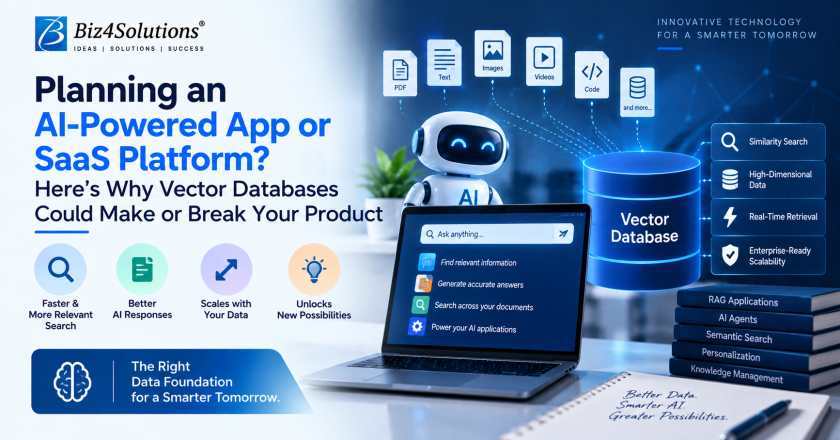
Planning an AI-Powered App or SaaS Platform? Here’s Why Vector Databases Could Make or Break Your Product
If you’re building a modern web platform, mobile app, or AI-powered SaaS product, you’ve probably heard terms like semantic search, AI copilots, or context-aware chatbots. But here’s the uncomfortable truth many product leaders discover too late:
Great AI features fail when the underlying data layer can’t support intelligent retrieval.
This is where vector databases quietly become a game-changer; not as a buzzword, but as a practical foundation for building AI-driven user experiences that actually work in production.
So, the real question is: If you’re investing in AI for your custom software product, are you building on the right data architecture?
What Problem Are You Really Solving with AI in Your Product?
Before choosing any AI stack, founders and CTOs need to ask:
1. Are we trying to build a smart search experience for users?
2. Do we want an AI assistant or chatbot that gives accurate answers from our data?
3. Are we building a recommendation engine for content, learning modules, products, or services?
4. Do we want to make large volumes of documents, knowledge bases, or user data searchable in natural language?
If the answer to any of these is “yes,” then traditional databases alone won’t take you far. AI systems don’t think in keywords; they work with meaning and similarity. That’s the gap vector databases fill.
Why Traditional Databases Fall Short for AI-First Web & Mobile Applications
Most enterprise applications still rely on relational databases built for transactions and structured records. They’re excellent for User profiles, Orders & payments, and Logs & system data.
But when you want features like:
· “Show me content similar to what the user liked.”
· “Let users ask questions in plain English.”
· “Retrieve relevant documents for an AI assistant.”
keyword-based search and rigid schemas start breaking down.
This is often where product teams feel AI is “overpromised;” not because AI doesn’t work, but because the backend architecture isn’t designed for AI-native experiences.
What Are Vector Databases (And Why Should Product Leaders Care)?
A vector database stores data in a way that allows your application to understand context and similarity, not just exact matches.
In real-world product terms, this enables smarter search inside web platforms, context-aware AI chatbots for customer support, personalized recommendations in SaaS products, and intelligent document search for enterprise users.
If you’re building:
· An AI-enabled SaaS platform
· A knowledge-heavy enterprise web application
· A mobile app with AI-driven discovery or assistance
vector databases become a core building block, not an optional add-on.
Building AI Features? Ask These Critical Product Architecture Questions
Before investing in AI features, CTOs and founders should challenge their roadmap with questions like:
1. How will our AI access and retrieve the right information?
2. If your AI assistant can’t find relevant product data, policies, or documents, users will lose trust fast.
3. Can our current tech stack scale when data grows 10x?
4. Vector-based search systems are built for scale. Retrofitting traditional systems later can be costly.
5. Are we designing this as an MVP hack or a production-grade system?
Many AI demos work in prototypes but fail in real-world SaaS environments due to poor architecture choices early on.
How will this integrate with our existing web, mobile, and SaaS ecosystem?
The answer is simple: AI features should blend naturally into your product experience; not feel bolted on. These are architecture decisions, not just AI decisions.
Real-World Use Cases We See in Custom Software Projects
When working with founders and enterprise product teams, we commonly see vector databases used in:
· AI copilots inside SaaS platforms for onboarding, support, and workflow guidance
· Enterprise search systems for large document repositories
· Learning platforms that recommend relevant content based on user behavior
· Customer support portals with intelligent ticket resolution
· Healthcare and fintech platforms that require accurate, context-aware retrieval
These are not “experimental” use cases anymore. They’re becoming baseline expectations for modern software products.
How Does This Impact Your Custom Software Development Strategy?
If you’re planning to build a custom mobile app, web platform, or AI-powered SaaS solution, the choices you make today will define:
· Your product’s scalability
· Your AI feature reliability
· Your time-to-market for future enhancements
· Your ability to compete with AI-native products
Many startups and enterprises underestimate the importance of AI-ready architecture during MVP development; and end up reworking their core systems later at a much higher cost.
Are You Designing for Today’s MVP or Tomorrow’s AI Roadmap?
A common mistake product leaders make:
“Let’s launch the MVP first. We’ll add AI later.”
The reality is, AI is not a feature you ‘plug in’ later. It needs thoughtful planning across: Backend architecture, Data pipelines, Cloud infrastructure, Security and compliance, and Performance and scalability.
This is where working with an experienced custom software development partner helps you design the right foundation from day one – across web, mobile, SaaS, and AI components.
Final Thought: AI Success Is 70% Architecture, 30% Algorithms
AI features don’t fail because models are weak. They fail because the product architecture isn’t designed for AI workflows.
If you’re a founder, CTO, or product owner planning:
· An AI-powered SaaS product
· A next-gen enterprise web platform
· A mobile app with intelligent experiences
the conversation shouldn’t start with “Which AI model should we use?” It should start with:
“Is our software architecture built for AI-first experiences?”
Planning a Custom AI-Enabled Web or SaaS Product?
If you’re evaluating how to architect your next web platform, mobile application, or SaaS product with AI-driven features, the right technical foundation can save you months of rework and massive technical debt later.
Happy to help you think through: AI-ready architecture, MVP vs scalable product design, and Cloud, data, and AI integration strategy.