How AI Agents Are Reducing Manual Work Without Removing Human Control

How AI Agents Are Reducing Manual Work Without Removing Human Control
AI Agents Workflow
If you’re evaluating AI agents for your business, the first question is rarely “Can this work?” The real question is: “Can this work without creating new risk?”
This is because nobody wants an automation success story that turns into an accountability mess. When a workflow breaks, a customer escalates, or a compliance flag appears, leaders don’t want to hear, “the model decided.” They want human control by design, with AI doing the heavy lifting and people keeping the steering wheel.
That’s exactly where AI agents are headed in 2025: reducing manual work dramatically while keeping humans firmly in charge.

Why “agentic” work is rising, but “hands-off” is still a myth

AI agents are different from chatbots. A chatbot answers. An agent can plan, decide, and execute steps across systems: pull data, draft outputs, route tasks, open tickets, reconcile records, generate reports, and trigger follow-ups.
But full autonomy isn’t what most businesses actually need. What they need is speed and consistency, without giving up supervision.
A useful reality-check comes from Gartner’s customer service research:only 20% of customer service leaders report AI-driven headcount reduction. This means most organizations are using AI to augment work rather than replace people outright.
That’s the point. AI agents reduce workload, improve throughput, and increase quality, but human oversight remains the operating model.

So, what does “human control” look like in an AI-agent workflow?

Not a vague promise. It’s a set of concrete system behaviors.

Human control means:

  • The agent can act, but only within defined boundaries (permissions, budgets, policies).
  • A human can approve, override, or roll back actions.
  • Every action is logged with context (what it saw, what it decided, what it changed).
  • Exceptions and high-risk decisions are automatically escalated.
If you’re a founder, CTO, or operations leader, you should be asking:
Which are the specific points in a workflow where human judgment is mandatory, and which are the ones that can proceed by default?
That one question determines whether your AI agent becomes a productivity asset or a governance headache.

The practical model: AI does the work, humans make the call

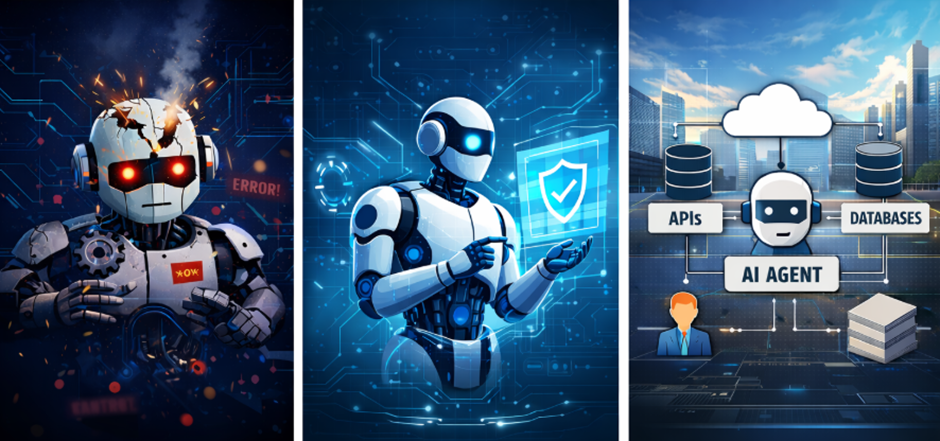
The winning pattern in 2025 is Human-in-the-Loop (HITL) and Human-on-the-Loop (HOTL).
Human-in-the-Loop: AI prepares, drafts, recommends, and routes; humans approve key steps.
Human-on-the-Loop: AI executes routine steps autonomously; humans supervise via dashboards and intervene when thresholds are crossed.
This is where AI agents shine; they remove repetitive effort without removing responsibility.
AI Agents Workflow

Where AI agents cut manual work the fastest

You don’t start by letting an agent “run the business.” You start where work is repetitive, rules exist, and exceptions can be escalated.

High-ROI examples (across industries) include:

Customer support operations: The agent summarizes tickets, suggests replies, retrieves policy references, drafts resolutions, and escalates edge cases.
Sales and CRM hygiene: The agent captures leads, enriches records, logs calls, drafts follow-ups, and routes opportunities while humans decide what to pursue.
Finance operations: The agent matches invoices, flags anomalies, prepares reconciliations, and drafts narratives for variances while finance approves.
HR workflows: The agent screens resumes against structured criteria, schedules interviews, and drafts candidate communications while recruiters make hiring decisions.
Procurement and vendor management: The agent compares quotes, drafts vendor emails, and prepares evaluation summaries while procurement signs off.
Notice the pattern: the agent handles volume and speed; humans own judgment and accountability.
AI Agents Workflow

The control mechanisms leaders should demand before going live

If you’re planning custom AI agent development, don’t approve a build that can’t answer these questions clearly:
1) What can the agent do, and what is it explicitly not allowed to do? Define permissions like you would for a human user. Least privilege wins.
2) Where are the approval gates? Decide which actions require confirmation: refunds, contract changes, regulatory decisions, customer account actions, pricing changes, and any “point of no return.”
3) How do we detect and handle exceptions? Agents perform best when the system treats exceptions as a first-class feature: auto-escalation, queueing, routing, and SLA timers.
4) Do we get a full audit trail? If you can’t replay what happened, you can’t manage risk, compliance, or disputes.
5) What’s the fallback when the agent is unsure? The agent should not guess its way through high-stakes steps. It should ask, escalate, or pause.
This is what “human control” actually means in production: not fewer humans, but better human leverage. Real-world implementations already show how this balance works at scale: our enterprise AI agent workflow example illustrates how manual effort can be reduced without losing human control.

The hidden reason AI agents fail is messy systems, not “bad AI.”

Designing AI-powered workflow systems that scale safely requires more than models; it requires strong data engineering, secure integrations, and thoughtful system design.
Many agent projects stall because the organization is trying to automate chaos. The process isn’t stable, the data isn’t trustworthy, and the systems aren’t integrated.
Before building agents, teams need a clean foundation: well-defined workflows, reliable data sources, role-based access, secure integrations (CRM, ERP, helpdesk, LMS, etc.), and event tracking and logs.
AI agents are not just an AI problem. They are software architecture + workflow design + governance.

What to build in 2025 if you want agent ROI without risk

If you want real impact without overreach, build agents as part of an operational system, not as standalone demos.

The practical roadmap looks like this:

  • Start with one workflow that is high-volume and measurable.
  • Build the agent as “assist-first,” with approvals.
  • Instrument everything: logs, metrics, failure reasons, and escalation paths.
  • Expand autonomy only when performance is proven and risk is contained.
This is how organizations reduce manual work while keeping control; autonomy is earned, not assumed.

Final thought

AI agents are not about removing humans from work. They’re about removing humans from repetitive work; so, they can focus on decisions, relationships, creativity, and accountability.
If you’re planning an agent initiative in 2025, here’s the leadership question that matters most:
Which parts of the process benefit from speedy execution, and which demand deliberate human validation?
Answer that well, and you’ll build AI agents that increase productivity without creating a trust problem.

Which AI Use Cases Are Actually Delivering ROI Today? A Practical Guide for CEOs, CTOs & Product Builders!

Which AI Use Cases Are Actually Delivering ROI Today? A Practical Guide for CEOs, CTOs & Product Builders!
Artificial Intelligence is no longer a futuristic add-on; it’s a revenue engine. Nearly 49% of technology leaders in a 2024 – 2025 survey said that AI was “fully integrated” into their company’s core business strategy, according to PwC. Yet even with these many organizations using AI, only a minority have turned these early experiments into production-scale ROI.
So the real question every technology leader is asking is:
“Which AI use cases will generate ROI fast, without requiring a massive overhaul of our tech stack?”
As a custom software development companydeeply involved in building AI, SaaS, mobile, and web applications, we evaluate this question daily with CEOs and product owners.
This guide breaks down real-world AI use cases that are genuinely producing measurable returns and how companies like yours can adopt them with minimal risk.

Why This Matters: Are You Investing in AI or Gambling with AI?

Before adopting any AI-powered solution, technology leaders want clarity on:
  • Which AI investments directly improve revenue or reduce costs?
  • What’s the payback period?
  • Which use cases can be embedded into custom web/mobile apps with low complexity?
  • How do companies ensure the model remains accurate, compliant, and secure?
Let’s explore the type of AI applications that are delivering proven, measurable ROI across industries, backed by real case examples.
AI Agents Workflow

1. AI for Lead Qualification & Sales Enablement (ROI: Improvement in Conversion)

Companies developing AI software for sales experience notice a significant increase in lead conversion rates. The ROI comes from faster lead scoring, automated follow-ups, predictive purchase likelihood, buyer intent classification, and pipeline forecasting.
An apt example of such a platform is LeadGenAI, a lead-generation platform built to generate higher-quality leads and faster qualification cycles, with features like automated outreach sequences and NLP-based message optimization.
Is this right for you?
Ask yourself:
  • Do your sales reps waste time on low-intent leads?
  • Do you lack insights into which leads convert?
  • Do you want AI-driven workflows integrated into your CRM or SaaS product?
If yes, this AI use case pays back extremely fast.

2. AI-Powered Automation of Manual, Repetitive Workflows (ROI: Cost Reduction)

AI can automate back-office tasks. High-ROI automation areas include document processing, data extraction, email classification and responses, report generation, appointment scheduling, and task prioritization.
Case Example: DataMine (AI for Data Extraction & Automation), an intelligent automation system that extracts structured data from unstructured documents, performs auto-classification, and reduces manual effort significantly.
ROI: Work that took hours now finishes in minutes.
Questions to assess fit:
  • Do your teams rely heavily on spreadsheets or manual data input?
  • Are there workflows repeated across departments?
  • Do you spend significant time reconciling or validating data?
This is usually the easiest and quickest AI project to execute.

3. AI-Powered Predictive Analytics (ROI: Efficiency Boost Across Operations)

Predictive analytics now drives real gains in demand forecasting, preventive maintenance, inventory optimization, and customer churn predictions.
Netflix is one of the most popular examples of predictive analytics in action. The platform analyzes billions of data points like watch history, viewing duration, interaction patterns, time-of-day behavior, and even pause/rewind actions, to predict what each user is most likely to watch next. This prediction-driven personalization is so accurate that over 80% of the content streamed on Netflix comes from its recommendation and prediction engine. The result is lower churn, higher engagement, and better content investment decisions.
Fits best for: Companies with structured data history like ERP logs, CRM activity, operations metrics, etc.

4. AI in Healthcare & Wellness Apps (ROI: Higher User Engagement + Reduced Support Load)

The healthcare industry has become one of the fastest adopters of AI.
Case Example: LifeFit AI, a wellness application that blends AI, computer vision, and integrated health data to deliver truly personalized fitness and nutrition insights. The platform includes AI-powered meal planning, speech-to-text food logging, and OCR/image & barcode recognition, allowing users to log meals simply by speaking, uploading photos, or scanning packaged items. By integrating with the Spoonacular API, the app instantly interprets food items, calculates nutritional value, and updates daily intake.
LifeFit AI also incorporates 3D body scanning (via Fit Xpress 3DLOOK) to track measurements and physical changes over time. It syncs with external fitness trackers and health apps to import steps, workouts, and activity data, enabling adaptive recommendations based on each user’s habits and goals. This combination of AI + APIs + real-time health data makes LifeFit AI a strong example of how intelligent wellness platforms can offer hyper-personalized guidance and improve long-term engagement.
Questions to consider:
  • Do you want to increase personalization in your app?
  • Can AI reduce dependency on human coaches/therapists?
  • Is real-time decision-making important for your product?
AI in wellness leads to better UX – higher stickiness – better monetization.

5. AI Chatbots & Virtual Assistants (ROI: Lower Customer Support Costs)

Businesses using AI chatbots can save up to 30% on operational expenses. (IBM) Use Cases include customer support, appointment management, HR onboarding, internal help-desks, eCommerce shopping assistants, etc.
Case Example: MindMentor AI (AI-driven Coaching Product), an AI-powered coaching assistant that detects emotional sentiment, guides users with structured cognitive frameworks, and provides actionable insights.
Shopify’s AI assistant Sidekick helps merchants perform tasks like generating product descriptions, analyzing sales data, creating marketing campaigns, and answering store-management questions. It works as a real-time co-pilot for business owners, showing how AI can streamline workflows and reduce operational overhead inside SaaS platforms.
To sum up, AI assistants are not limited to customer support; they can deliver deep, personalized guidance across industries.

6. AI in Recommendation Systems (ROI: Increase in End-User Spend)

Amazon showcases one of the world’s most effective recommendation engines, using AI to personalize product suggestions, surface relevant alternatives, and predict what each customer is most likely to buy. Similarly, Spotify leverages AI-driven recommendation models to curate personalized playlists like Discover Weekly and Daily Mix, driving user engagement through hyper-tailored music discovery.
These systems work exceptionally well in eCommerce, EdTech, media platforms, and SaaS products with complex user journeys. By delivering personalized product suggestions, behavior-based nudges, and automated content curation, recommendation engines significantly amplify user engagement and conversion rates.

7. Generative AI for Content, Code, and Design (ROI: Productivity Gains)

Generative AI is reshaping how modern teams create, build, and iterate. Tools like GitHub Copilot help developers write and debug code faster, while platforms such as Canva Magic Studio and Adobe Firefly enable designers to instantly generate layouts, visuals, and creative variations. Even productivity apps like Notion AI assist teams by summarizing content, drafting documents, and automating routine writing tasks.
High-ROI GenAI use cases include auto-generating UI components, producing marketing content, summarizing customer chats and feedback, writing SQL queries, creating reports, and generating QA test cases.
Companies planning custom software should evaluate GenAI-driven internal tools to accelerate app development timelines and boost overall efficiency.

8. AI for Fraud Detection & Document Verification (ROI: Loss Reduction + Faster Approvals)

AI-powered fraud detection and document verification have become standard across industries such as FinTech, Insurance, Logistics, and digital onboarding platforms. Popular services like Stripe Radar use machine learning to identify suspicious transactions in real time, while platforms like Onfido and Jumio automate identity verification by analyzing IDs, facial biometrics, and behavioral patterns. These examples highlight how AI-driven verification can drastically reduce manual review time and eliminate fraudulent activity early in the process.
ROI is generated by instant fraud flagging, automated verification, faster customer onboarding, and reduced manual review time; all of which streamline operations and protect businesses from financial and compliance risks.

9. AI in Personalized Learning & Coaching Platforms (ROI: Higher User Retention + Scalable Expertise)

The demand for personalized, self-paced guidance is exploding, and this is where AI-powered learning and coaching assistants truly shine. MindMentorAI is a strong example: it delivers structured cognitive frameworks, learns user behavior patterns, and adapts guidance dynamically, making it highly suitable for EdTech platforms, employee learning systems, or personal growth products. Built using LangChain, the platform acts as an AI copilot that stays aligned with coaching principles. It supports voice interactions through speech-to-text and text-to-speech, allows users to upload documents for tailored summaries and coaching prompts, and provides real-time refinement controls such as like/dislike and rephrase.
Behind the scenes, MindMentorAI includes a secure admin panel for managing coaching topics, prompt libraries, and subscription-based access. With advanced prompt engineering, safety guardrails, voice integration, and multi-tenant tooling, it demonstrates how AI agents can deliver scalable, personalized coaching experiences, similar to how AI phone agents or virtual tutors operate.
Another real-world example is Duolingo, which uses AI to personalize language-learning paths, predict where a learner may struggle, and adjust lesson difficulty dynamically. Its AI-driven feedback, automated pronunciation evaluation, and personalized practice sessions demonstrate how adaptive learning systems boost engagement and improve learning outcomes at scale.

10. AI-Enhanced Mobile & Web Apps with Smart Features

Modern applications, whether SaaS, mobile, or enterprise, are increasingly expected to be intelligent by default. Leading apps like Google Photos use AI for smart search and automatic tagging, while Gmail enhances productivity with features like Smart Compose and Smart Reply. Similarly, platforms like Notion and Slack now integrate AI-driven suggestions, summarization, and contextual recommendations to streamline user workflows.
Trending smart features include voice commands, intelligent search, auto-tagging, personalized recommendations, and proactive notifications. Adding even a single AI-powered layer to an existing app can dramatically enhance user experience, increase engagement, and improve retention.
AI Agents Workflow

How Should CEOs & CTOs Decide Which AI Use Case to Build First?

Use this quick checklist:
  • Do we have a clear, measurable business outcome? (Revenue increase, cost savings, time reduction)
  • Do we have the minimum data required? (No need for “big data;” clean, relevant data wins.)
  • Can AI integrate into our existing mobile/web/SaaS platform?
  • Will end users actually feel the improvement?
  • Can we start with a small Proof-of-Concept in 3–6 weeks?

Recommended First Steps for Companies Planning AI Adoption

  • Start with an AI Business Discovery Workshop: Clarify key processes that drain time, data currently available, quick-win opportunities, and long-term automation roadmap.
  • Build a small POC before a full product: Avoid investing big until you validate model accuracy, user acceptance, and integration complexity.
  • Modernize your tech stack only where needed: Most companies can integrate AI without rewriting their entire platform.
  • Plan for security & compliance, especially for Healthcare, Finance, Legal, and HR domains.
  • Iterate fast as AI improves with usage.

Final Thoughts:

AI ROI Is Real If You Choose the Right Use Cases
AI will not magically fix broken processes. But when applied strategically, especially inside custom SaaS apps, mobile apps, enterprise systems, or automation workflows, it delivers fast, clear, measurable return on investment.
For entrepreneurs and technology leaders, the path is simple: identify a high-impact workflow, start small with a POC, and scale intelligently. With the right approach, AI becomes not a cost center, but a competitive advantage.
Extra title if needed
AI hype is loud. ROI is quiet. These use cases prove what actually works.