
Building a healthcare mobile app is one thing. Building a mobile platform that can responsibly handle electronic protected health information, or ePHI, is another.
For founders and CTOs planning a patient engagement app, telehealth platform, remote monitoring solution, healthcare SaaS product, or AI-enabled clinical application, HIPAA is often discussed too late in the development lifecycle.
The assumption is usually: encrypt the database, secure the login, add audit logs, and the application is “HIPAA-compliant.”
That is not what the HIPAA Security Rule requires.
The current Security Rule requires regulated entities to implement administrative, physical, and technical safeguards that protect the confidentiality, integrity, and availability of ePHI. Its technical safeguards focus on five areas: access control, audit controls, integrity, authentication, and transmission security.
For a HIPAA-compliant mobile app development project, those requirements need to influence the architecture, APIs, cloud environment, mobile application, and operational workflows from the beginning.
First, What Does “Technical Safeguard” Actually Mean?
HIPAA is intentionally technology-neutral.
It does not tell your development team to use a particular framework, cloud provider, database, authentication platform, or encryption library. HHS instead requires reasonable and appropriate safeguards based on factors such as the organization’s size, capabilities, infrastructure, costs, and risks to ePHI.
That distinction matters.
A HIPAA-ready architecture is not created by assembling a standard checklist of technologies. It starts by understanding:
Who should access the data, what they should be allowed to do with it, where the data travels, and how unauthorized activity will be detected.
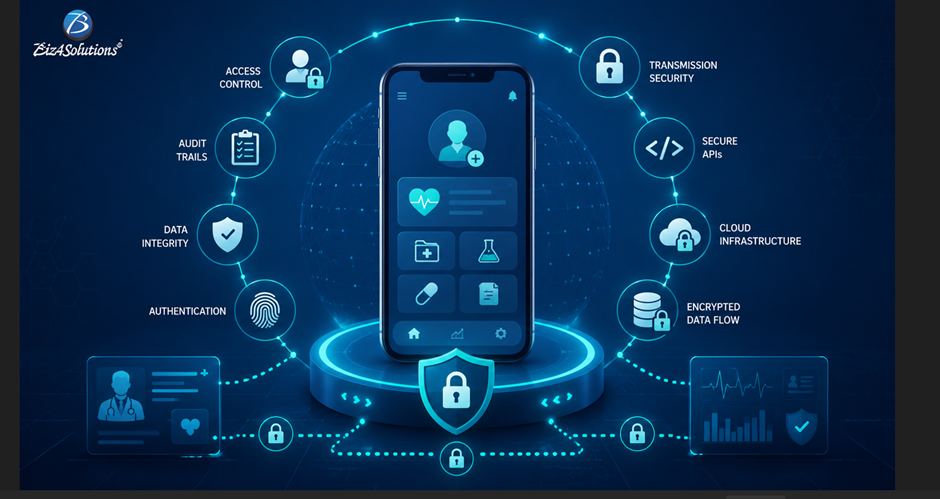
Let’s translate each technical safeguard into practical mobile software decisions.
1. Access Control: Who Can See What?
HIPAA requires technical policies and procedures that allow ePHI to be accessed only by people or software programs that have been granted appropriate access rights.
For healthcare mobile applications, this goes much deeper than adding username-and-password login.
Consider a patient engagement platform used by patients, physicians, nurses, support teams, and administrators.
· Should every physician see every patient?
· Can customer support access clinical notes?
· What happens when a clinician leaves the organization?
· Can an administrator change permissions without that event being recorded?
A sound custom healthcare software development architecture may therefore include role-based or attribute-based authorization, tenant-level isolation, server-side permission validation, session expiration, controlled administrative privileges, and immediate access revocation.
One principle is particularly important:
Do not rely on the mobile interface to enforce sensitive permissions.
Hiding a button in an iOS or Android app is not access control. Authorization must ultimately be enforced by the backend systems protecting the data.
2. Audit Controls: Can You Reconstruct What Happened?
The Security Rule requires mechanisms capable of recording and examining activity in systems that contain or use ePHI.
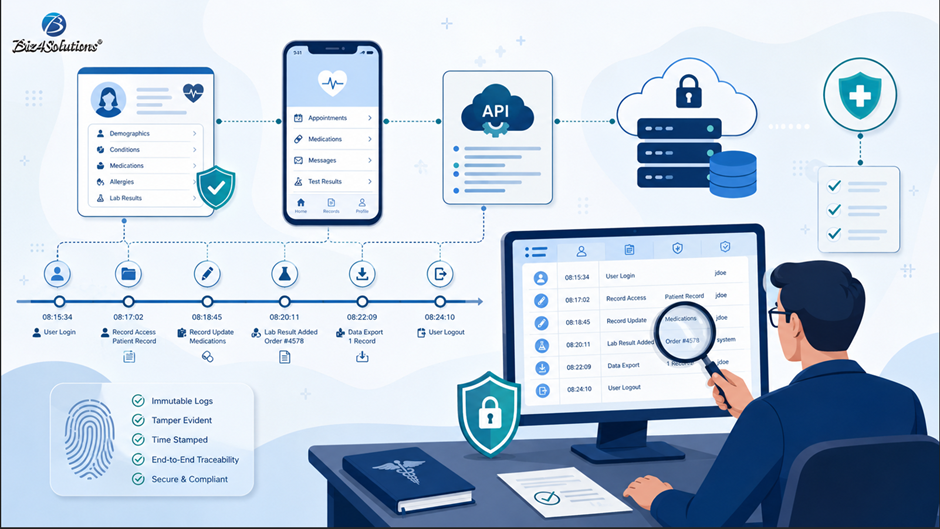
A generic application log is not necessarily a useful audit trail. For example: “Patient record updated.”
That tells an investigator very little. A better audit architecture may need to establish:
· Who accessed the record?
· Which record was involved?
· What action occurred?
· When did it happen?
· Did the user’s permissions change?
· Was information downloaded or exported?
· Did repeated failed access attempts occur?
The important word here is examine.
Audit controls should help security and compliance teams understand events after they happen, not simply prove that a log table exists.
For CTOs evaluating a healthcare mobile app development company, ask the development team to demonstrate how an incident would actually be reconstructed from the logs.
That question reveals far more than asking whether “audit logging is supported.”
3. Integrity: How Do You Know the Data Wasn’t Improperly Changed?
Healthcare systems depend on trustworthy information.
HIPAA requires policies and procedures designed to prevent ePHI from being improperly altered or destroyed and, where appropriate, electronic mechanisms capable of confirming its integrity.
Think about what this means in a mobile application.
A prescription instruction, clinical note, diagnostic document, care plan, or patient-submitted measurement may pass through several systems before reaching its destination.
Engineering teams should therefore consider questions such as:
· Can unauthorized users modify this information?
· Can APIs reject manipulated requests?
· Can important records be overwritten without traceability?
· How will the organization detect an unauthorized change?
Integrity protection can involve application permissions, transaction controls, versioning, secure APIs, validation, immutable or append-only records for selected events, and monitoring.
The exact technical approach depends on the risk. The requirement is not “use technology X.” The requirement is to protect ePHI from unauthorized alteration or destruction.
4. Authentication: Is the User Really Who They Claim to Be?
Authentication and authorization are often confused.
Authentication answers: “Who are you?”
Authorization answers: “What are you allowed to access?”
HIPAA requires procedures for verifying that a person or entity seeking access to ePHI is the one claimed.
For a modern healthcare application, authentication architecture may involve secure identity providers, multi-factor authentication where appropriate, short-lived access tokens, secure refresh-token handling, device and session management, account recovery procedures, and protections against credential attacks.
Mobile design introduces additional questions:
· Where are authentication tokens stored?
· What happens if a phone is lost?
· Can active sessions be remotely revoked?
· What happens after a password reset?
Does biometric authentication merely unlock a local application session, or does the backend independently validate authorization?
Strong authentication is not simply a better login screen. It is an identity lifecycle.
5. Transmission Security: What Happens When ePHI Leaves the Device?
Healthcare mobile applications constantly move information.
A mobile client talks to an API. The API calls another service. Documents move to storage. Patient data may flow into an EHR integration. A video consultation crosses another network. An AI capability may communicate with an external model service.
HIPAA requires technical measures protecting ePHI against unauthorized access while it is transmitted across electronic networks.
That means development teams need to map the complete journey of ePHI.
Transport encryption is an essential component, but teams should also think about certificate validation, API authentication, secure service-to-service communication, integrity protection, expired credentials, integration security, and data transmitted to third parties.
A useful architectural question is: Can we draw every place where ePHI enters, leaves, or crosses a trust boundary?
If the answer is no, the security architecture is not finished.
What About Encryption?
Encryption deserves special clarification. Many teams use “HIPAA encryption” as though it were a single product requirement.
The current Security Rule contains required and addressable implementation specifications, and the appropriate implementation depends on risk analysis and the circumstances of the regulated entity. HHS emphasizes that “addressable” does not mean optional in the casual sense; organizations must assess whether a specification is reasonable and appropriate and document their decisions where relevant.
HHS has proposed changes that would strengthen Security Rule requirements, including broader encryption requirements, but those proposals should not be confused with the rule currently in effect. HHS explicitly distinguishes its current Security Rule from the proposed modifications.
For product teams, the practical message is simpler:
Encrypt sensitive healthcare data based on a deliberate security architecture, not merely because a compliance checklist says “encryption.”
The Mobile App Is Only One Part of HIPAA Architecture
A frequent mistake in healthcare mobile application development is securing the iOS or Android client while ignoring the wider ecosystem.
A healthcare platform may include:
mobile apps, web portals, APIs, cloud infrastructure, databases, object storage, EHR integrations, notification providers, monitoring systems, video services, analytics tools, and AI APIs.
ePHI can potentially move through several of these components.
That is why HIPAA technical safeguards should be implemented across the entire information system, not only inside the mobile application.
For example, securing a database means little if patient information is subsequently written into unrestricted application logs.
Similarly, an encrypted mobile connection offers limited protection if the backend API permits one tenant to retrieve another tenant’s records.
Can Custom Development Support HIPAA Compliance?
Yes.
Custom mobile application development can absolutely support a HIPAA-compliant solution when security and compliance requirements are incorporated into architecture, engineering, infrastructure, vendor management, and organizational processes.
Custom development can provide greater control over identity, authorization, encryption, logging, data storage, APIs, tenant isolation, infrastructure, AI integrations, and auditability.
But it is important to phrase this correctly:
Custom software does not automatically make an organization HIPAA-compliant.
The Security Rule also contains administrative and physical safeguards, and compliance includes organizational policies, risk management, workforce practices, incident procedures, vendor relationships, and documentation.
Technology enables compliance. Technology alone does not complete it.
What Should a CTO Ask Before Development Begins?
Before approving a healthcare mobile platform, ask five questions:
· Where will ePHI exist throughout the entire system?
· Who can access it, and how are those permissions enforced?
· Can we reconstruct sensitive activity from our audit records?
· How is ePHI protected when stored and transmitted?
· What happens when a user, device, API, integration, or vendor is compromised?
If those questions cannot be answered before architecture begins, adding “HIPAA compliance” to the requirements document will not solve the problem later.
Build the Safeguards Into the Architecture
For entrepreneurs and technology leaders, the key lesson is straightforward:
HIPAA technical safeguards are not features to bolt onto a finished healthcare app. They are design constraints that should shape the platform from day one.
At Biz4Solutions, our approach to healthcare mobile app development connects mobile engineering, web platforms, cloud architecture, APIs, SaaS development, security, and AI integration as parts of the same system.
Whether you’re planning a telehealth product, patient engagement application, healthcare SaaS platform, remote monitoring solution, or AI-enabled healthcare product, the more useful question is not:
“Can we make this HIPAA-compliant before launch?”
It is: “Are access control, auditability, data integrity, authentication, and transmission security already built into the architecture we’re approving today?”
That is where HIPAA-ready software development really begins.