
 AI agents are rapidly becoming core components of software products; from intelligent customer support systems to autonomous workflow managers and recommendation engines within SaaS platforms. Yet many conversations focus on the wrong concern, often overstating the risk of autonomy.
 The real risk with AI agents isn’t autonomy, it’s poor design!
For founders, CTOs, and technology leaders planning to build custom AI-enabled web, mobile, or enterprise software, this distinction is not just theoretical. It directly impacts product quality, user trust, regulatory compliance, and business outcomes.
When Do AI Agents Fail? Hint: It’s Not Because They’re Autonomous
Most AI failures in production are not caused by autonomy. They stem from fundamental engineering gaps.
Before blaming autonomous AI agents for unpredictable behavior, ask this:
Was the system engineered with solid design principles, or was it treated like an experiment?
From our experience designing and building large-scale AI-driven SaaS systems and mobile platforms, most failures originate from four key design flaws:
1. Undefined decision boundaries Many teams deploy AI with vague goals instead of defined scopes and constraints, leading to unpredictable outputs.
2. Missing feedback loops Without rigorous mechanisms for learning and correction based on outcomes and user behavior, AI doesn’t improve; it drifts.
3. Lack of observability If you cannot trace why an agent made a decision, you cannot fix it under real-world conditions. Production systems require logs, confidence scores, and explainability layers, not black boxes.
4. No human-in-the-loop governance True autonomy is rare in mission-critical systems. Even autonomous components should have escalation paths and override controls.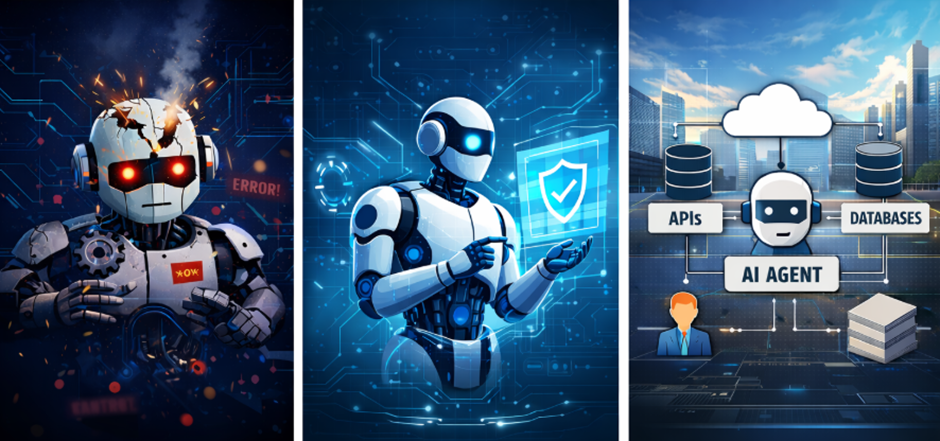
AI Adoption Is Exploding, So Is Design Complexity
AI adoption is now mainstream across enterprise and consumer software. What was once experimental is now embedded directly into production environments. This means AI agents are no longer isolated components; they must operate within distributed systems that include microservices, event-driven pipelines, external APIs, cloud-native infrastructure, and real-time user interfaces across web and mobile platforms.
In practice, AI agents are expected to manage state, respect business rules, handle failures gracefully, integrate with identity and access controls, and perform reliably under variable load; all while interacting with constantly evolving models and data sources. Without deliberate architectural choices, these systems quickly become fragile, opaque, and difficult to govern.
This is why the conversation must shift from how autonomous AI agents should be to how they should be designed 
What Separates Reliable AI Agents from Risky Ones?
Here’s a critical question for every technology leader planning custom AI software:
Is your AI agent engineered like an integrated software component — or treated like a prompt-in-a-box?
Reliable AI agents have:
- Structured state management, not open-ended reasoning loops
- Clear policies, guardrails, and escalation criteria
- Tight integration with cloud services, APIs, databases, and business logic
- Fail-safe behaviors with deterministic fallbacks when confidence is low
Well-designed AI becomes like any other high-quality software module: predictable, testable, and maintainable.
What Should Founders and CTOs Ask Before Building AI Agents?
If you’re planning custom AI-powered products, these questions will uncover risk early:
- How do we define business logic and guardrails around the AI agent’s decisions?
- Can we trace and explain each decision the agent makes?
- What happens when the model output conflicts with business rules?
- How does the AI agent interact with mobile, web, and backend systems?
- What monitoring and alerting mechanisms are built in?
If these have no clear answers yet, the risk isn’t autonomy, it’s architectural immaturity.
Why Poor Design Is More Dangerous Than Autonomy
Autonomy amplifies design flaws; it doesn’t create them.
A poorly designed AI system fails faster, impacts users more widely, and becomes more expensive to fix. Autonomy does not make a system “intelligent” in a business sense. It makes a system brittle without solid design discipline.
For entrepreneurs and CTOs delivering custom software, the goal should never be “fully autonomous AI.” It should be safe, explainable, and robust AI embedded within well-engineered systems.
How to Build AI Agents That Are Safe, Scalable, and Business-Ready
Production-grade AI agents require more than models. They need:
- Strong backend architecture across web and mobile platforms
- Secure and scalable API orchestration
- Business rule engines integrated with AI outputs
- Thorough observability, including logging and metrics
- Human-in-the-loop systems for supervision and overrides
- Cloud-native infrastructure for resilience and scaling
This is where experienced software partners; with deep expertise in custom AI, SaaS, cloud, web, and mobile development, deliver real value. The difference between a chaotic AI launch and a reliable AI service is design rigor. 
Final Takeaway: Neglect, Not Autonomy, Is the Real Risk
AI autonomy is a red herring. The real danger lies in letting AI slip into software systems without proper architectural rigor.
The most successful AI-powered products won’t be those with the most autonomy. They will be those with the smartest limits, best observability, and strongest integration with real-world business logic.
If you are a founder or CTO planning to develop custom AI-enabled software – whether web, mobile, or SaaS – ask the right questions early. The smarter your design, the more reliable your AI agent will be.