

For decades, match preparation depended on a familiar combination of experience, scouting reports, video review, and coaching instinct. Those fundamentals still matter. What has changed is the speed and depth of the information available around them.
Today, AI-powered sports analytics and computer vision technology can help teams track player movement, positioning, acceleration, ball activity, tactical shape, workload, and recurring game patterns almost continuously.
For coaches, analysts, academies, leagues, and sports-tech companies, this creates a new opportunity: move from simply reviewing what happened to understanding why it happened and what should change next.
The challenge is no longer collecting more sports data. It is turning that data into insights quickly enough for coaches to use.
From Match Footage to Actionable Data
Traditional sports analysis often starts with someone watching video and manually tagging important moments.
Computer vision changes that workflow.
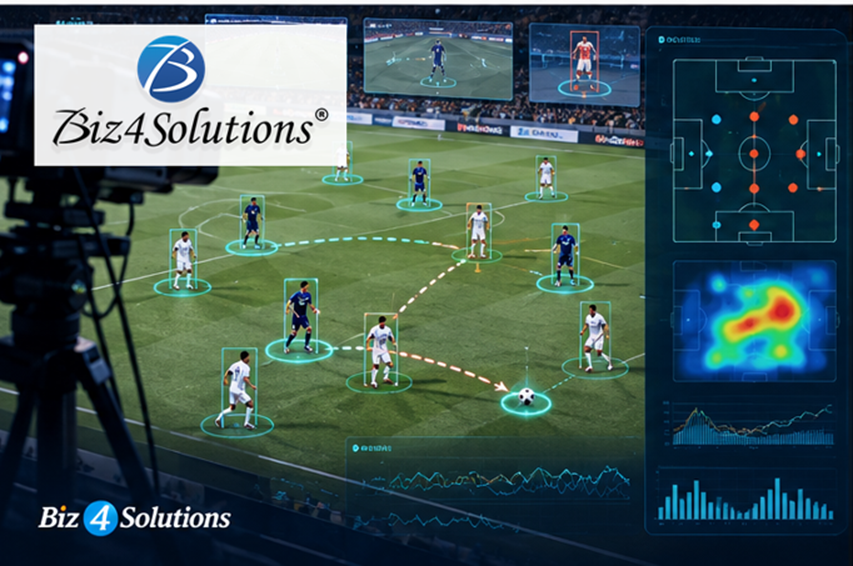
Modern camera systems can detect players, follow movement, identify objects, map positions, and convert video into structured information that software can analyze.
The sophistication of tracking technology is already visible at the highest levels of sport. FIFA’s semi-automated offside technology uses dedicated cameras to track the ball and up to 29 data points on each player 50 times per second, allowing precise positional analysis.
Although FIFA primarily uses this technology for officiating, the underlying capability has much broader implications for performance analysis. Once player and ball movement become machine-readable, coaches are no longer limited to watching isolated video clips. They can begin analyzing patterns across entire matches.
1. Coaches Can Analyze Space, Not Just Events
Traditional statistics tell us who passed, tackled, shot, or scored. But coaches often care about what happened before the event.
· Why did the passing lane open?
· Why was a defender pulled out of position?
· How quickly did the team recover after losing possession?
· Was the midfield compact enough during transition?
Computer vision can help reconstruct these moments using positional data. Instead of reviewing only the final shot, a coaching staff could examine the movement of every player in the seconds leading up to it. That makes analytics more tactical.
A goal is no longer just a goal. It becomes a sequence of positioning, spacing, movement, pressure, and decision-making that can be studied and compared.
2. AI Can Dramatically Reduce Analysis Time
Professional teams already collect large quantities of data. The problem is finding what matters. A coaching analyst may have hours of match footage, thousands of tracking events, multiple player-performance metrics, and several previous games to review before the next fixture.
AI can help reduce that workload by classifying events, identifying recurring patterns, finding similar sequences, and linking data back to relevant video. Instead of manually searching through five matches, an analyst could eventually ask:
“Highlight every instance where our defensive line was exposed after we lost possession in midfield.”
The system could retrieve the matching sequences and present them alongside positional or performance data. That changes the role of analytics. The objective is no longer producing more reports. It is helping coaching teams reach the right evidence faster.
3. Opposition Analysis Becomes More Specific
Preparing for an opponent often means looking for tendencies.
· How do they build from the back?
· Which side do they attack most frequently?
· What happens when they are pressed high?
· Where does their defensive shape break?
AI-assisted sports analytics can make those questions more precise.
A custom sports analytics platform could combine computer-vision tracking with tagged events and historical video to identify repeatable situations.
For example, coaches could examine:
· How an opponent responds to a particular pressing structure
· Which players create space during transitions
· Where defensive gaps repeatedly appear
· Which passing combinations lead to dangerous attacks
· How formations change between possession and defensive phases
This does not replace tactical expertise. It gives coaches better evidence for applying it.
4. Player Performance Can Be Viewed in Context
A player’s maximum speed or total distance covered can be useful. But those figures alone rarely capture the full picture.
· Why was the sprint made?
· Was the player closing down an opponent?
· Recovering after a turnover?
· Creating space?
· Making an overlapping run?
Tracking data becomes far more valuable when physical output is connected to game context.
The NFL’s Next Gen Stats system illustrates the volume of information now available in professional sport. It tracks player location, speed, distance traveled, and acceleration 10 times per second, generating more than 200 new data points on every play. The NFL also uses machine learning to derive higher-level performance metrics from that tracking data.
For coaches, the opportunity is to combine physical and tactical information.
Instead of asking only, “How hard did the player work?” teams can ask, “Was that workload contributing to the tactical objective?”
5. Computer Vision Can Make Analysis More Accessible
Elite clubs can employ large performance departments and sophisticated tracking systems. Smaller organizations often cannot. Computer vision can potentially reduce some of that gap.
If software can automate player tracking, event detection, video tagging, and tactical visualization from existing camera feeds, teams may need less manual effort to generate useful insights.
That matters for:
The long-term opportunity is not simply better analytics for the world’s largest clubs. It is making sophisticated analysis more accessible to organizations that previously could not support dedicated analytics teams.
6. Real-Time Analytics Can Change Preparation Between Games
The phrase real-time sports analytics can be misleading if it implies that AI should make tactical decisions for the coach during competition. The greater opportunity is often reducing the time between an event and useful analysis.
Imagine a coaching staff preparing for the next match. Instead of manually reviewing an entire game, the analytics platform has already identified:
The coaching team begins preparation with evidence already organized. Human experts still interpret that evidence. AI accelerates the path to it.
What Does a Real-Time Sports Analytics Platform Need?
A production-ready AI sports analytics solution requires much more than a computer-vision model.
The underlying platform may need to combine live or recorded video, player detection, object tracking, sensor data, real-time event streams, historical databases, AI/ML inference, searchable video, analytics dashboards, APIs, and mobile access for coaching teams.
The technical challenge is making all those components work together reliably.
A proof-of-concept model that identifies players in a video is one thing.
A platform capable of processing multiple camera feeds, synchronizing tracking data, storing match history, generating tactical insights, and presenting results quickly is a much larger software engineering problem.
That is where AI development, cloud infrastructure, data engineering, mobile development, and web application development converge.
The Biggest Challenge Is Not AI. It Is Workflow.
A technically impressive analytics system can still fail if coaches do not use it. The platform must fit naturally into the coaching workflow. If finding a useful insight requires moving between several dashboards, exporting spreadsheets, or asking an analyst to manually locate video, the system creates friction.
A better experience connects the entire journey:
This is where product design becomes as important as model accuracy. Sports teams do not need AI for the sake of AI. They need faster access to information that improves preparation.
Can AI Replace Coaching Instinct?
It should not.
Sport contains variables that data cannot always explain completely: confidence, fatigue, tactical instructions, player chemistry, match pressure, opponent behavior, and countless human factors.
AI can process more information than a coaching team could reasonably review manually. But identifying a pattern and understanding its importance are two different things. The strongest systems therefore act as decision-support tools. They help coaches identify patterns, test assumptions, and find supporting evidence faster.
The coach still decides what matters.
The Future of Coaching Is Data-Assisted, Not Data-Driven Alone
AI and computer vision are changing sports preparation because they allow teams to transform video and tracking information into searchable, contextual insights. Competitive advantage will come from how effectively data is turned into actionable intelligence—not from simply accumulating more of it.
Many teams can do that. It will come from building systems that turn the right information into the right coaching decision at the right time. For organizations considering custom sports analytics software development, that means thinking beyond the AI model.
The real product combines computer vision, machine learning, real-time data pipelines, scalable cloud architecture, intuitive dashboards, mobile applications, and workflows designed around how coaches actually prepare.
At Biz4Solutions, we view sports analytics as a connected software engineering problem—not simply a computer-vision experiment. Because in competitive sport, better data is useful. But faster understanding is what changes the game.